Showing posts with label Culture War. Show all posts

Sunday, July 24, 2016

What is Truth?

The collective chaos and insanity that seems to be casting its shadow over over the world has led me to to the thought: How does this come to be, that human beings are so willing, even eager, to cast aside the humanity of other people and, instead, to view them as objects that need to be destroyed? Why does the world seem to descending (as my pastor put it in his Sunday homily) descending into a "collective nervous breakdown?"  What first comes to mind is that humanity, as a whole, seems to be experiencing the same phenomenon that anyone might experience individually when their perception of reality, of who they are, who others are, and what the relationship between them ought to be becomes detached from what they actually are or ought to be. We are receiving the full prescription of idolaters, accounted by St Paul in his letter to the Romans (bold emphasis mine):
The wrath of God is indeed being revealed from heaven against every impiety and wickedness of those who suppress the truth by their wickedness. For what can be known about God is evident to them, because God made it evident to them. Ever since the creation of the world, his invisible attributes of eternal power and divinity have been able to be understood and perceived in what he has made. As a result, they have no excuse for although they knew God they did not accord him glory as God or give him thanks. Instead, they became vain in their reasoning, and their senseless minds were darkened. While claiming to be wise, they became fools and exchanged the glory of the immortal God for the likeness of an image of mortal man or of birds or of four-legged animals or of snakes. Therefore, God handed them over to impurity through the lusts of their hearts for the mutual degradation of their bodies. They exchanged the truth of God for a lie and revered and worshiped the creature rather than the creator, who is blessed forever. Amen. Therefore, God handed them over to degrading passions. Their females exchanged natural relations for unnatural, and the males likewise gave up natural relations with females and burned with lust for one another. Males did shameful things with males and thus received in their own persons the due penalty for their perversity. And since they did not see fit to acknowledge God, God handed them over to their undiscerning mind to do what is improper. They are filled with every form of wickedness, evil, greed, and malice; full of envy, murder, rivalry, treachery, and spite. They are gossips and scandalmongers and they hate God. They are insolent, haughty, boastful, ingenious in their wickedness, and rebellious toward their parents. They are senseless, faithless, heartless, ruthless. - Romans 1:18-31

Originally Posted July 18, 2011

What is Truth?

Those three words, asked of Jesus by Pilate as he stood falsely accused (cf. John 18:38), reverberate through history.  They seem to be amplified today, at a time when so many in our culture searching for the answer without finding it, or worse, have given up asking the question altogether.  Despite the temptation to give up in the face of what seems to be so much diversion and misinformation, the question has to be asked and cannot be avoided, for Truth cannot be found unless it (He) is sought with sincerity of heart.  The greatest danger lies when the seeker asks the question as a "loaded" question, with unmovable skepticism, and refuses to believe that it can lead to any answer other than that it is unanswerable.

The question, and the scene that surrounds it, are the centerpiece of the Pope's discussion in Chapter 4.  He begins the chapter by reflecting briefly on the prerequisite condition of freedom, that eventually leads into the deeper discussion:
The participation of everyone in power is the hallmark of freedom.  No one is to be merely the object of rule by others or only a person under control; everyone ought to be able to make a voluntary contribution to the totality of political activity.  We can all be free citizens only if we all have a genuine share in decision making.
So, to be truly free, we must all be able to contribute our "two cents," and know that our opinions are heard, weighed, and valued.  But being free in the sense of society does not mean being free to act on whatever whim we choose.  That freedom itself has to be anchored, grounded in something:
...the freedom of the individual to order his own life is declared to be the real goal of societal life.  Community has no value whatever in itself but exists only to allow the individual to be himself.  However, if the individual freedom...as the highest goal lacks contents, it dissolves into thin air, since individual freedom can exist only when freedoms are correctly ordered.
So our freedom must be ordered, or oriented, toward something in order to have meaning.  But, if we have billions of people, each a sovereign, what common goal or purpose can their freedom all be oriented toward?  Probably the most common and widely accepted answer is the "common good" (i.e. the best possible opportunity for each individual to reach their full human potential, not to be confused with the collective good of society at large). But even the "common good" of man remains vague and has to be further defined and grounded.

When it comes to evaluating the ultimate goal of a democratic form of government, digging deeper into the meaning of the common good leads to one of two positions.

1. First, the radical relativistic position, which makes the governing activity itself the highest source of good, by replacing the historical, Christian concept of good and goodness with the idea that will of the majority ultimately decides and comes to occupy the position of "truth."  This is the secular-humanistic view, and is the basis of pure democracy.

2. Second, the "truth first" argument that, to quote the Holy Father, "truth is not a product of politics (the majority) but is antecedent to political activity and sheds light on it.  It is not praxis that creates truth but truth that makes praxis possible." This is the Christian view, and is the foundation of the republican form of government that began to be explored even before the time of Christ by Plato and Aristotle, where certain preexisting realities (what our Founders referred to as inalienable rights) set boundaries on the power of the state, which derives its power, in turn, from the consent of the people.

In his conclusions, the Pope notes that, in order to properly fulfill its role of regulating society the state must "[create] a balance of freedom and good things that allows each individual to lead a life worthy of man." This requires some power to guarantee the law, but it must remain clear that the government must use its power to "safeguard the rights of each individual and the welfare of all.  It is not the task of the state to create mankind's happiness, nor is it the task of the state to create new men. It is not the task of the state to change the world into paradise--nor can it do so."

The bottom line is that, to preserve freedom grounded in truth, that state must "receive from outside itself the essential measure of knowledge and truth with regard to that which is good."  Further,
According to Maritain, the primary right of a people to govern itself can never become a right to decide everything.
This reality--the clashing of  two opposing views--plays out briefly and dramatically in the exchange between Christ and Pilate.  Referring to the German scholar Heinrich Schlier, who wrote against groups within the Protestant churches who cooperated with the buildup of National Socialism, the Holy Father notes that, according to Schlier,
...although Jesus in his trial acknowledges the judicial authority of the state represented by Pilate, he also sets limits to this authority by saying that Pilate does not possess this authority on his own account but has it "from above" (19:11).  Pilate falsifies his power, and...the power of the state, as soon as he ceases to exercise it as the faithful administrator of a higher order that depends on truth.
Jesus didn't comment on which specific form of government would best serve the needs of man and society, but he did lay out, in this exchange, what a government--no matter what its form--could never do.  It could never take the place of God or supplant his truths with the will of a fallible majority.  The minute it seeks to do so, and attempts to eliminate him from the position of ultimate authority, it loses any legitimate claim of power.

+AMDG+

Saturday, December 13, 2014

Muslim Go Boom! - WND Commentary by Matt Barber

This is by far the best commentary/op-ed I've come across all week.  Matt Barber (entertainingly) argues the stark truth, that:

Sunday, August 10, 2014

Identity Crisis

So my girls have completely fallen in love with the Lion King.  Who would've thought, a 20-year-old Disney flick would capture their attention, and so quickly supplant Frozen? Well, partially anyway.  It's their (and, by proxy, my) favorite character story du jor, so...yes I'm going to go there and write about a Disney movie on a blog about cultural warfare.

As we were watching it during one of our recent Friday pizza-and-movie nights, the story eventually came to the scene where the now-adult Simba, who was driven out by the searing indictment of his conniving and power-hungry uncle Scar, begins to ask questions and wonder what he's supposed to be doing with his life.  Sounds familiar, right?  Young man grows up with little or no guidance, and suddenly finds himself an adult groping for direction in his life.  As Simba starts seeking for answers, he is led by Rafiki, the wise sage baboon, to look at his own reflection.  At first he finds it pointless, but directed back again by Rafiki, he looks deeper into his image for that of his father.

Here's the scene:


So...could we consider this snippet from a children's story in the light of our own wandering and groping for identity?  How often have we given into the accusations of the world, particularly of the accuser, the father of lies (cf. John 8:44)?  How often do we believe that we can't do it, that we're not good/strong/handsome/beautiful/holy/worthy enough of the lofty tasks set aside for us from the foundations of the world?    Most of the time this slide into believing the accusations doesn't happen out of malice, so much as it does because we take the easy road out to satisfying our deep-seeded human need for belonging and acceptance.

After all, isn't it so much easier just to allow the answers in through our five senses--from the world--than to take the time to look inside, to recognize and water the seed that our Creator has put in us? Instead of looking to the One who so desires to be the ultimate source of our affirmation, for who we are, we allow noise and din of the world to begin to answer the question for us.  And the answer is... "You are only as (fill in the blank with a desirable trait) as we say that you are."  We can even begin to let the accusations and the anxiety that flows from them define us.  We trade the peace and freedom that comes from grounding in the truth of who we are for the worry and bondage of believing lies.

I know I have.  A lot.  I will forever be a recovering lie-believer.

But those lies are not who we are or what we were made for.

St. Paul gives us what is arguably the most poignant reminder of who we are in his Letter to the Romans (8:14-17):
For those who are led by the Spirit of God are children of God.
For you did not receive a spirit of slavery to fall back into fear, but you received a spirit of adoption, through which we cry, “Abba, Father!”
The Spirit itself bears witness with our spirit that we are children of God, and if children, then heirs, heirs of God and joint heirs with Christ, if only we suffer with him so that we may also be glorified with him.
Let's rewind and review that one more time.  So, according to St. Paul we are:

1. Children of God.  That is, children of a perfect Father, who wants us to call him "Daddy!" as obedient children do, more than "Master."

2. Joint heirs with Christ.  Our Lord, the second person of the Trinity, by descending into our humanity, now raises us up to a share in the glory of his divinity. Christ came and suffered for us--and the ultimate Father sacrificed his only son--so that we could be like him in all things but being.  (A previous post from June 3, 2013, Gods and Goddesses, has more on that).  The Second Person of the Trinity lowered himself to walk among us as brother and friend.

Think about that.  Let it sink in, and do it often, because that is the point of truth that the enemy most wants us to forget.

Paul also reminded his spiritual son, Timothy, as he gave him encouragement and "marching orders" in his second letter: "For God did not give us a spirit of cowardice but rather of power and love and self-control." (2 Tim 1:7)

Of course.  That only makes sense.  God doesn't remake us into his children, ask us to call on him as Daddy, then just leave us to our own fallen, weak, broken devices.  That would be the ultimate cruelty, (another of the original lies, the first proposed in the garden:"Does he really want what's best for you, or is he holding out?" [cf. Gen 3:1,5]).

The truth is quite the opposite: He gives us everything we need, although that is seldom what we think we need. The refrain of the old Lonestar song, Mountains, comes to mind. "The good Lord gave us mountains, so we could learn how to climb."

Other words come to mind, from St Thomas More, about how incapable we are of judging our own needs and controlling our fate in this life.
So blind are we in this mortal life, and so unaware of what will happen, so uncertain of even how we will think tomorrow, that God could not take vengeance on a man more easily in this world than by granting his own foolish wishes.
Saint Thomas More

So what are we to do with this?  The implications of being The answer to that could be a whole other book, volumes really, and I'll have to write more about that later (Part 2?).  But for now, let it suffice to say that we only need to follow Mufasa's advice:

Remember who you are.  That is, sons, daughters, and heirs of the living God, the King of kings, who are called to struggle and suffer toward perfection now so that we might rejoice and share in his glory forever.

No more and no less.

+AMDG+

Wednesday, August 6, 2014

European court: Gay marriage is not a human right - Lifesite News

This is stunning (for me, anyway...in a good way) and is the last thing I would have expected to come out of the European Human Rights Court.  The first sentence from the summary paragraphs below almost had me pinching myself:
The court confirmed that the protection of the traditional institution of marriage is a valid state interest—implicitly endorsing the view that relations between persons of the same sex are not identical to marriage between a man and a woman, and may be treated differently in law.
The judgment says that European human rights law recognizes the “fundamental right of a man and woman to marry and to found a family” and “enshrines the traditional concept of marriage as being between a man and a woman.” It explains how no European consensus on same-sex marriages exists, as only 10 of the 47 countries bound by the treaty allow such designations.
Read the entire article here.

Monday, July 14, 2014

The Crisis in Society is a Crisis of Fatherhood (AudioSancto)

WARNING!!! Includes statements that are non-PC, gender distinct, and highlight rather than diminish the differences in needs between girls and boys that only father in shaping childrens' identity.  "Church of nice" listeners beware!

This is a tremendous sermon by one of our local priests, one of many posted weekly at http://www.audiosancto.org/.


Download link: http://files.audiosancto.org/20140615-The-Crisis-in-Society-is-a-Crisis-of-Fatherhood.mp3

Here are links to the books referenced by the priest (I have not had a chance to read them yet, but have them on my list and look forward to posting a few more tidbits):


Legacy: A Father's Handbook for Raising Godly Children by Steve Wood 


Father, The Family Protector by James Stenson

Saturday, July 12, 2014

The Good of Government by Roger Scruton

The conservative movement in America so often finds itself responding to the tidal wave of progressivism and expansionist government, instead of offering the good and natural (and necessary) function of government.  In this must-read piece, Roger Scruton summarizes the philosophical and natural law origins of conservatism, of the limited-government roots that have made the American experiment so unique, and what conservatives must do to regain the offensive in the culture war.

"Conservatives therefore have an obligation to map out the true domain of government, and the limits beyond which action by the government is a trespass on the freedom of the citizen.  But it seems to me they have failed to offer the electorate a believable blueprint for this, precisely because they have failed to see that what they are advocating is not freedom from government, but another and better kind of government..."
The Good of Government by Roger Scruton - First Things

Friday, July 4, 2014

Independence Day Reflection - When Is It Okay to Disobey?

A happy and blessed Independence Day!


On this 238th birthday of our nation's independence from imperial rule, as we celebrate the blessings of liberty given to us by God and by those who have fought tirelessly to gain and preserve it, I thought I'd get started up again by reposting an oldie-but-goodie from a few years ago (March 1, 2010, to be exact).

In this reflection from the March-April 2010 issue of Catholic Answers (formerly This Rock) magazine, Fr. Frank Pavone reflects on the enormous responsibility of living as a Christian in a free society, and addresses many of the same issues as Dr. King and Pope Benedict XVI (see my previous posts from January 24 and January 31, 2010).  He writes from the same tradition and understanding of the relationship between divine law and human law as St. Thomas Aquinas in his Summa Theologica and Dr. King in his Letter From a Birmingham Jail (excerpts below).

Please God, let us never forget in the ins-and-outs of the daily political grind, that God's law supersedes any law created by man, always and everywhere, and that it is our responsibility to carry his truth into the here-and-now (Catechism of the Catholic Church 1897-1904 and 2234-2243).

When Is It Okay to Disobey?
Catholics and Civil Disobedience
By Fr. Frank Pavone

Imagine for a moment that a law were passed in our country outlawing attendance at Mass. What would you do? Certainly campaigns would be launched to change the law, to challenge the law in court, and to elect new leaders who would reject such a law. 


But those processes could take years. The question is, what would you do in the meantime? Would you go to Mass anyway? If you are a priest, would you celebrate Mass anyway? Are there times when you would disobey the law and consider that disobedience to be morally justified?


This question goes to the heart of who we are as Christian citizens and of the relationship of the Church to the state.

The King Is Subject to a King
The Old Testament provides an excellent starting point for this question in 1 Samuel 8. The people of God are living on the land the Lord gave them. All around them, other nations are worshipping strange gods and engaging in strange rituals. One of the differences between God’s people and these other nations was that the other nations had a king. The people of Israel were always talking about the Lord, the Covenant, and the Commandments God gave to Moses, but they didn’t have a king.

So one day they go to the prophet Samuel, and ask, “Would you give us a king, please? All the other nations around us have a ruler that leads them into battle and fights their wars and provides for them, and we don’t have a king.” Samuel says, “What are you talking about? The Lord is your king!” “Yes, but we want a king like the other nations,” they reply.

So Samuel turns to the Lord, who tells Samuel to grant their request but also to warn the people that they’re going to suffer for it. And several chapters later we read the instructions that Samuel gives to the people. He says to them, "You said to me, no we want a king to rule over us. But the Lord your God was your king and now behold the king whom you have chosen, for whom you have asked. Behold, the Lord has set a king over you. If you will fear the Lord and serve him and hearken to his voice and not rebel against the commandment of the Lord and if both you and the king who reigns over you will follow the Lord your God it will be well. But if you will not hearken to the voice of the Lord and rebel against the commandment of the Lord, then the hand of the Lord will be against you and your king." (1 Sm 12:12b-15)

A hierarchy is established: The people obey the king. The people and the king obey the Lord.

If you read through the history of the Old Testament, you’re actually reading the history of two kingdoms interwoven one with another, the Northern Kingdom (Israel) and the Southern Kingdom (Judah). And you soon discover that you are reading theological history. In other words, the events happened, but you are reading them from the perspective of God and understanding the God-related reasons why certain armies won the battles and others lost. 


What Scripture is trying to convey is not the brilliant political strategies or the terrible blunders, but rather the fact that when the people and their king observed and obeyed the Covenant, things went well and God delivered their enemies away from them. But when they—often at the urging of their king and because of his sinfulness—violated the Covenant, God delivered them into the hands of their enemies.


The prophets arrived to admonish the kings and to instruct the people. The role of the prophets is very clear in the Old Testament: to reproach the kings, telling them again that they need to be faithful to the Covenant.

We Have the King’s Responsibilities
You and I are in a position today in America that gives us even more responsibility than the prophets had when they spoke to the kings. We too are prophets by our baptism into Christ. We have a prophetic role, not in the sense of telling the future but of speaking the present, interpreting present events in the light of the Word of God. We do it as clergy when we preach, but we all do it as baptized members of the faithful when we bear witness to the Word of God in our daily life. We bear greater responsibility because we have more than just the opportunity to speak to our “kings,” our rulers, those in government authority. We have the opportunity to choose them—an opportunity that the people in the Old Testament never had. We have the power to choose them. And if our system of governance works the way it’s supposed to work, we in fact govern ourselves.

What this means is that all the scriptural responsibilities that God places on the sovereign, on the king, on the ruler, are placed on us! If you read the Bible from the beginning to the end you see a whole series of very serious responsibilities placed on the shoulders of the ruler of the people. The ruler of the people was to do justice, reaffirm the Covenant, lead the people in the ways of the Lord, promote peace, defend life, and rescue the poor and the widow. All of the responsibilities of the sovereign and their people are now on us. We don’t only have the responsibility that belongs to the people; we have the responsibility that belongs to the sovereign because of our ability, our opportunity to take part in the political process.

The Church’s Yes and No
What, then, does the Church think about the state? Historically, beginning with Jesus himself, it has said to governments at the same time yes and no. And the Church maintains a delicate balance between her yes and her no. In his book, Church and State in Early Christianity, Hugo Rahner writes, “The Church has never confronted the state with a ‘no’ of inflexible refusal dictated by another worldly mysticism or with a ‘yes’ of unqualified acceptance based on political indifference. The Church of the martyrs with a sure political instinct illuminated by grace knew how to find a balance between ‘yes’ and ‘no.’”

Let’s look more closely at that yes and no.

First, the Church says a profound yes to the state, and this is rooted in a very simple fact: All authority, all power, comes from God. Therefore obeying earthly, civil authority becomes part of our obedience to God.

Scripture is filled with examples of this. Perhaps one of the most striking is in the book of the prophet Jeremiah. Even when the state and the powers of civil authority are persecuting believers, believers are exhorted to be good citizens. We read that God’s people are being taken into exile in Babylon. Yet they’re not told to create a revolution. They’re not called to overthrow the Babylonians. What are they called to do? 


Thus says the Lord of hosts, to the exiles whom I have sent into exile from Jerusalem to Babylon: Build houses and live in them. Plant gardens and eat their produce. Take wives, have sons and daughters. Take wives for your sons that they may bear sons and daughters. Multiply there, do not decrease. Seek the welfare of the city where I have sent you into exile and pray to the Lord on its behalf for in its welfare you will find your welfare. (Jer 29:4-7)


Seek the welfare of the city even if the city is holding you in exile.


We’re even more familiar with the New Testament exhortations. Peter, for example says:


Maintain good contact among the Gentiles, so that in case they speak against you as wrongdoers they may see your good deeds and glorify God . . . Be subject for the Lord’s sake to every human institution, whether it be to the emperor as supreme or to governors . . . Honor all men, love the brotherhood, fear God, honor the emperor. (1 Pt 2:12-13, 17) 


And then of course we find the exhortation to pay taxes and the example of Jesus paying the temple tax and taking the coin out of the mouth of the fish to do so.


So to put it simply, the fact that we are citizens of heaven (Phil 3:20) does not give us the right to ignore our duties as citizens of earth. One of the old criticisms of religion is that because we focus on the world to come we are less concerned about this one. But the Church’s teaching has always been very clear: Preparing for the world to come makes us more concerned about this one. After all, we want to spend eternity with the person next to us. God is preparing for us new heavens and a new earth—not some kind of totally disconnected world that has nothing to do with the things that go on in this life. 


Nonetheless, the Church also says a clear no to the state. That no is grounded in the very nature of a kingdom not of this world. When Pilate asked Jesus if he was a king, Jesus replied that his kingdom was not of this world (Jn 18:36). When Jesus was asked, “Is it lawful to pay the tax to Caesar? ,” notice what Jesus does in response. He asks whose image and inscription are on the coin. They say “Caesar’s.” “Then give to Caesar what is Caesar’s,” he tells them (that’s the yes to the state) “but give to God what is God’s” (that’s the no; see Mt 17:24-27, 22:17-21). In other words there’s something higher here. There’s a duty to be given. Now, from where does that duty flow? Think of what he said. The coin belongs to Caesar because it bears the image of Caesar, so give it to him. But “give to God what belongs to God.” That belongs to God which bears the image of God, namely human beings—including Caesar himself! So Christ establishes the framework. Caesar himself belongs to God. The state itself belongs to God.


The Church has always taught that the state does not contain the fullness of human hope or embrace the totality of human existence. The state exists for the human person, not the other way around. Our destiny, ultimately, is the new heavens and the new earth. So we can never put our ultimate hope and trust in what the state can do for us. In this consists the Church’s no to the state. It frees us from the myth of some kind of political salvation. The Church is the first to say that we are not asked to put ultimate hope and trust in any political party, candidate or system. Those things do play a key role but never merit our ultimate hope or trust. Our destiny is not comprised by this world alone. 


That does not mean, however, that we can shirk our responsibilities. We can’t walk away saying, “Oh, we can’t rely on those people anyway; they’re all crooked, they never keep their promises.”

God’s Law Comes First
In this context, then, we can return to the question with which we began. What would we do if a law were passed in our country outlawing attendance at Mass?


Hopefully, we would have the courage to disobey it. 


The Catechism asserts in its own words the Church’s yes and no to the state in sections 1897-1904 and again in 2234 to 2243. It explains that we are “resident aliens.” Our citizenship is in heaven, and only there is our ultimate loyalty. Hence, if that loyalty conflicts with our loyalty to civic authority, loyalty to God must prevail.


Having said this, the Catechism then explicitly talks about the proper role civil disobedience can play, if circumstances warrant. We have to obey authority, it reminds us. But the role of authority “is to ensure as far as possible the common good of the society” (1898). Sometimes authority will fail in doing so.


It explains such a circumstance in this way:


Authority does not derive its moral legitimacy from itself. It must not behave in a despotic manner, but must act for the common good as a moral force based on freedom and a sense of responsibility: A human law has the character of law to the extent that it accords with right reason, and thus derives from the eternal law. Insofar as it falls short of right reason it is said to be an unjust law, and thus has not so much the nature of law as of a kind of violence. (1902)


Authority is exercised legitimately only when it seeks the common good of the group concerned and if it employs morally licit means to attain it. If rulers were to enact unjust laws or take measures contrary to the moral order, such arrangements would not be binding in conscience. In such a case, authority breaks down completely and results in shameful abuse. (1903)


Our duty in such cases is explained a bit later in the Catechism:


The citizen is obliged in conscience not to follow the directives of civil authorities when they are contrary to the demands of the moral order, to the fundamental rights of persons or the teachings of the Gospel. Refusing obedience to civil authorities, when their demands are contrary to those of an upright conscience, finds its justification in the distinction between serving God and serving the political community. “Render therefore to Caesar the things that are Caesar’s, and to God the things that are God’s.” “We must obey God rather than men”:


When citizens are under the oppression of a public authority which oversteps its competence, they should still not refuse to give or to do what is objectively demanded of them by the common good; but it is legitimate for them to defend their own rights and those of their fellow citizens against the abuse of this authority within the limits of the natural law and the Law of the Gospel. (2242)

The Right to Life
In our day, the most egregious example of the failure of civil authority to maintain the common good and protect human rights is in the legalization of abortion and euthanasia. Applying the Catechism’s teachings, Pope John Paul II wrote at length about civil disobedience in his encyclical, Evangelium Vitae (The Gospel of Life):


Laws which authorize and promote abortion and euthanasia are therefore radically opposed not only to the good of the individual but also to the common good; as such they are completely lacking in authentic juridical validity. Disregard for the right to life, precisely because it leads to the killing of the person whom society exists to serve, is what most directly conflicts with the possibility of achieving the common good. Consequently, a civil law authorizing abortion or euthanasia ceases by that very fact to be a true, morally binding civil law.


Abortion and euthanasia are thus crimes which no human law can claim to legitimize. There is no obligation in conscience to obey such laws; instead there is a grave and clear obligation to oppose them by conscientious objection. From the very beginnings of the Church, the apostolic preaching reminded Christians of their duty to obey legitimately constituted public authorities (cf. Rom 13:1-7; 1 Pt 2:13-14), but at the same time it firmly warned that “we must obey God rather than men” (Acts 5:29). In the Old Testament, precisely in regard to threats against life, we find a significant example of resistance to the unjust command of those in authority. After Pharaoh ordered the killing of all newborn males, the Hebrew midwives refused. “They did not do as the king of Egypt commanded them, but let the male children live” (Ex 1:17). But the ultimate reason for their action should be noted: “the midwives feared God” (ibid.). It is precisely from obedience to God—to whom alone is due that fear which is acknowledgment of his absolute sovereignty—that the strength and the courage to resist unjust human laws are born. It is the strength and the courage of those prepared even to be imprisoned or put to the sword, in the certainty that this is what makes for “the endurance and faith of the saints” (Rv 13:10).


In the case of an intrinsically unjust law, such as a law permitting abortion or euthanasia, it is therefore never licit to obey it. (EV 72, 73)


Surveying these teachings briefly, we find that the Church first of all calls us to do everything we can within the law to correct injustices. That is why we must be politically active and fully utilize our democratic system to change laws that fall short of the very purpose of law.


Secondly, when circumstances justify acting outside the law, we are never justified in committing acts of violence or otherwise violating human rights. Moreover, in judging whether circumstances for civil disobedience prevail, we have to exercise the virtue of prudence and always seek the guidance of others so that we do not rely solely on our own judgment.


Finally, it is clear that civil disobedience is not in any way disrespect for the law, because unjust laws are not bad laws, but no laws at all. Defending human rights in peaceful ways outside “the law” is ultimately a form of defense of and respect for the law. Civil disobedience, in defense of human rights, is actually divine obedience.

No Longer Law but a Perversion of It

As Augustine says (De Libero Arbitrio i, 5) “that which is not just seems to be no law at all”: wherefore the force of a law depends on the extent of its justice. Now in human affairs a thing is said to be just, from being right, according to the rule of reason. But the first rule of reason is the law of nature, as is clear from what has been stated above. Consequently every human law has just so much of the nature of law, as it is derived from the law of nature. But if in any point it deflects from the law of nature, it is no longer a law but a perversion of law.
Some things are therefore derived from the general principles of the natural law, by way of conclusions; e.g. that “one must not kill” may be derived as a conclusion from the principle that “one should do harm to no man”: while some are derived therefrom by way of determination; e.g. the law of nature has it that the evil-doer should be punished; but that he be punished in this or that way, is a determination of the law of nature.
Accordingly both modes of derivation are found in the human law. But those things which are derived in the first way, are contained in human law not as emanating therefrom exclusively, but have some force from the natural law also. But those things which are derived in the second way, have no other force than that of human law.
—Summa Theologiae I-II:95:2
Bound to a Higher Law

How does one determine whether a law is just or unjust? A just law is a man made code that squares with the moral law or the law of God. An unjust law is a code that is out of harmony with the moral law. To put it in the terms of St. Thomas Aquinas: An unjust law is a human law that is not rooted in eternal law and natural law. Any law that uplifts human personality is just. Any law that degrades human personality is unjust. . . . One who breaks an unjust law must do so openly, lovingly, and with a willingness to accept the penalty. I submit that an individual who breaks a law that conscience tells him is unjust, and who willingly accepts the penalty of imprisonment in order to arouse the conscience of the community over its injustice, is in reality expressing the highest respect for law.  Of course, there is nothing new about this kind of civil disobedience. It was evidenced sublimely in the refusal of Shadrach, Meshach, and Abednego to obey the laws of Nebuchadnezzar, on the ground that a higher moral law was at stake. It was practiced superbly by the early Christians, who were willing to face hungry lions and the excruciating pain of chopping blocks rather than submit to certain unjust laws of the Roman Empire. . . .
—Martin Luther King, Jr., Letter from a Birmingham Jail, April 16, 1963

Fr. Frank Pavone is founder of the Missionaries of the Gospel of Life, a society of apostolic life dedicated to the formation and training of priests, deacons, brothers, and seminarians who will devote themselves fully to the proclamation of the gospel of life. He is also the national director of Priests for Life, an officially approved association of Catholic clergy who give special emphasis to the pro-life teachings of the Church. Contact Priests for Life at http://www.priestsforlife.org/.

Tuesday, December 24, 2013

The Five W's Part Two: Who We Believe and Worship (Part 1 of 2)

"For Jews demand signs and Greeks look for wisdom, but we proclaim Christ crucified, a stumbling block to Jews and foolishness to Gentiles, but those who are called, Jews and Greeks alike, Christ the power of God and the wisdom of God." (1 Corinthians: 22-24)

I once heard it said that, if you really want to know someone, you've got to know where they came from and where they're headed.  The only thing that could probably be added to that is the present.  Along with the past and future, you've got to know someone's here and now, to meet them in their present life circumstances.  To really enter into relationship, in particular the type of caritas or agape relationship that God calls us to, and that we are called to seek out in each other, there has to be a genuine interest in the heart, in seeking out what influences push and pull it, and a willingness to enter into the broken and ugly pieces that we all carry around with us.

This is one way I've been led to approach the the question, "Who is Christ?  Who is this man that we claim worship as God?"    We could spend an eternity exploring and reflecting on the person of the God-man, of mystery of Emmanuel (God with us) and, by his grace, one day we will...for eternity. After all, isn't that what heaven is about?  Isn't it about being immersed in the power of divine relationship, of perfect love incarnate, and of the unlimited truth, goodness, and beauty that we only catch fleeting and limited glimpses of during our walk in this valley of tears?  Isn't it living with full consciouness and perfect knowledge of the One who not only created us, but who loved us with such self-abandon that he lowered himself to give up his life, choosing mercy beyond justice so as not to leave us in the squalor and suffering of our sin?  If not I'm not sure that I would want any other idea of heaven, or any other God, at least for eternity.

As for there here and now, I'll  narrow it to the question of the Who of The Five W's: the person of Christ as One who came to enter into relationship with us and literally save us from ourselves, in the past, present, and future.  He took on a human identity without giving up his divinity so that we might know that, despite our frail humanity, we are no longer bound by the pain of our past, by our present circumstances, or by the future that we so often look into with both hope and fear because we are so powerless to control it.  By entering into our humanity, he literally bent time, condescending (lowering himself) to at once dwell with us as the fulfillment of the hope of our ancestors in faith, as leader and our constant companion on our life's journey, and to raise us to the intended dignity and show us the glorious destiny he has won for us and destined us for by his passion, death, and resurrection.

Past
In the December 16th reflection of Watch for the Light: Readings for Advent and Christmas, entitled Genealogy and Grace, Gail Godwin offers a reflection on Matthew's purpose in beginning his Gospel by recounting the genealogy of Christ (Matthew 1:1-17), and particularly his inclusion of people who were "...not necessarily the noblest or most deserving person[s] to carry out divine purposes."
For reasons unknown to us, God may select the Judahs who sell their brothers into slavery, the Jacobs who cheat their way to first place, the Davids who steal wives and murder rivals - but also compose profound and beautiful psalms of praise.
And what about the five women Matthew choses to include? Not a mention of Sarah or Rebekah or Rachel, the upstanding patriarchal wives of Israel.  Instead Tamar, a Cananite, who disguised herself as a prostitute and seduced her father-in-law Judah to get a son out of him.  And Rahab, another Cananite and a real prostitute this time.  And Ruth the Moabite, another outsider.  And Bathsheba, mother of Solomon, is named only as the wife of Uriah, whom King David had killed so he could marry her himself.  Every one of these women used as God's instrument had scandal or aspersion attached to her-as does the fifth and final woman named in the genealogy: Mary, the mother of Jesus, with her unconventional pregnancy.
Matthew's intent in highlighting these women is to make the point that Christ, who as God was able to plan and choose his own lineage, did so in a way that made a bold and profound statement: that he desired to come to us not with the appearance and glory of God (as he is and will return), but in the humility of a 100% human being with very much imperfect ancestors.  In doing so, took on our sin not by sinning himself, but by assuming the sins of the past and all time onto himself. At the same time, in choosing to singularly exempt Mary from this stain of sin, he reversed our trajectory from darkness and sin to light and redemption and prepared for himself a perfect flesh-and-blood tabernacle from which to enter into the world.  Christ chose to enter the nastiness, pain, and fear, and death of a fallen humanity rather than abandon us to the fate we deserved.  He chose love and mercy beyond justice.  Only God could plan that kind of entrance.

And that is where we are arrive at Christmas.  Light has pierced the darkness.  God with us has come into the world, to take the burden of our fallen and broken state onto himself, beginning with the past, because only he as God is strong enough and wise enough to rid us of it once and for all.

+AMDG+

Monday, October 28, 2013

The Five W's Part One: Why I Believe

"Always be ready to give an explanation to anyone who asks you for a reason for your hope." (1 Peter 3:15)

As I mentioned in the introductory post on the Five W's, these posts on these five basic questions of the faith won't be in any particular order.  In fact, I'll just start with the order in which I've been led to think about them, beginning with...

"Why do I believe?"

The opening imperative issued by St Peter, as with all imperatives, is given for a reason.  In the case of effectively understanding and explaining why we believe, it's because, without an answer to this question first, all of the other questions of faith become a moot point.  At our most basic level, we operate off of needs and desires.  Our God realizes that.  In fact, he made us that way.  He created to desire his truth, goodness, and beauty.  Unfortunately, those desires have become twisted and distorted, and the recognition an acceptance of that fact leads to the first part of the answer to the question of why.

1.  I believe because I recognize that I am not as I ought to be, and the world is not as it ought to be.

I look out at the world around me, and at the same time into my own soul, and realize that, although there is truth, goodness and beauty, and a desire for more of it, without end, I am constantly disappointed by my own failings, the failings of people around me, and of society at large.  I know that the good things, the truly good things, of this life seem so fleeting, but I cannot believe that the desire for truth, goodness, and beauty, can not have come into my mind and heart without an object, and without some echo of knowledge of how things ought to be.  As the Sugarland song "Something More" go,

There's gotta be something more, gotta be more than this
I need a little less hard time, I need a little more bliss
I'm gonna take my chances, taking a chance I might
Find what I'm looking for
There's gotta be something more

2. There is evil in the world.

Evil seeks to lie, destroy, and kill.  It is real.  It exists, yet it has been said that its greatest achievement is convincing the world that it doesn't.  It is so important to convince the world that it doesn't exist because confronting evil, especially the sin in each of our souls, is something we are utterly powerless to do on our own.  However, when we do decide to confront it, to seek healing and truth (if we are honest), and that search for healing and truth leads us to look outside ourselves.  See #1.

3. Yet, despite the evil, there is still so much good.

Despite all the evil that we encounter during our sojourn in this valley of tears, there is still so much good, beginning first and foremost with the human heart.  Though society would minimize the power of the human heart, we see its capacity to do good, especially in helping neighbors in the face of suffering.  Though it may sound sort of like a cheesy movie line, there is a hero in each of us, capable of great love and ultimately called to shine brighter than the stars.   We have the capacity to bring and do so much good in the world.  Evil never has the last laugh.  As the great Christian apologist C.S. Lewis put it,

“How monotonously alike all the great tyrants and conquerors have been; how gloriously different are the saints.”

4. I will die. Yet, because of my experience of good, however fleeting in this life, I cannot believe that death is the end.

A dear priest friend once began one of his homilies with that simple statement: I will die. Let that sink in for a minute.  In fact, try to spend a few minutes a day--particularly at day's end--allowing it to make the journey from head to heart, not in a dark, obsessive, and avoidant way, but in an acceptance of reality that allows one to look beyond it.  So many of the great saints have encouraged frequent contemplation of the moment of our death because it keeps us grounded in our humanity and limitations.  In fact, one of the greatest successes of evil in more affluent society is in removing so much of the reality of human death from our immediate experience.  Yet it remains the disease that we cannot cure, the effect of our allowance of sin into the world.  But, thinking back to #3, just as I know that evil does not have the last laugh in the world, I cannot believe that its primary objective of death and destruction has the last word, particularly for those who believe in the One who has conquered death and who makes all things new.  That is why the Resurrection is so important: because without it, death continues to reign as the great tyrant and scourge over humanity.  But in the Resurrection its power has been routed; it has been transformed into the beginning of eternal life.  Faced with that choice, the uncertainty and lack of resolute answers the world gives about the condition it cannot fix vs. the promise of eternal life made concrete by Christ's Resurrection, I choose the latter every time.

Psalm 84:1-5, 11-13, is a constant reminder of the beauty of God's dwelling place, which he has given us a taste of here on earth and calls us to enter into with him.  After all, he seeks to create a space for himself, a little heaven if you will, in each human heart; a place over which death and the pain of our human condition have no power.

How lovely your dwelling
O LORD of hosts!
My soul yearns and pines
for the courts of the LORD.
My heart and flesh cry out
for the living God.


As the sparrow finds a home
and the swallow a nest to settle her young,
My home is by your altars,
LORD of hosts, my king and my God!


Blessed are those who dwell in your house!

They never cease to praise you.
Better one day in your courts
than a thousand elsewhere.


Better the threshold of the house of my God
than a home in the tents of the wicked.


For a sun and shield is the LORD God,
bestowing all grace and glory.
The LORD withholds no good thing
from those who walk without reproach.


O LORD of hosts,
blessed the man who trusts in you!

+AMDG+

Monday, October 14, 2013

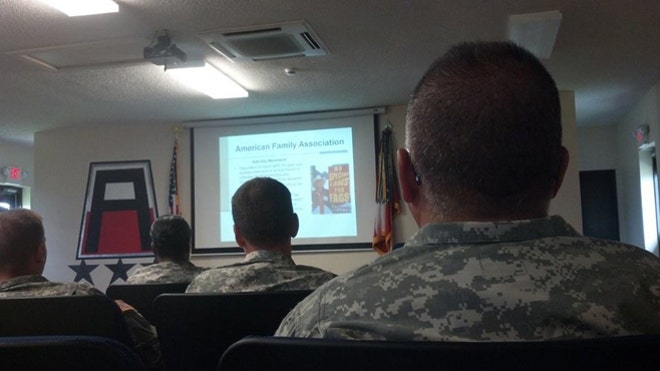
US Army defines Christian ministry as 'domestic hate group'

EXPANDED 10/16/2014

Another day, and another instance of our own military being turned against the prevailing views of the majority of its citizens:

US Army defines Christian ministry as 'domestic hate group'

I have to agree with Todd Starnes' conclusion, that "it appears the Obama administration is separating the military from the American people – and planting seeds of doubt about Christians and some of our nation’s most prominent Christian ministries."

What pains me the most is, having spent the first decade-and-a-half of my adult life in the military, I know and have seen the power of the warrior ethos and the camraderie brought about through our military traditions.  However, when those traditions pull away from (or are pulled away from; shifts like this don't happen by accident), the bedrock beliefs of the nation that gives birth to them--in our case, the Judeo-Christian ethical and moral structure and willingness to sacrifice for the good of the whole--the seed is planted for the ideal of the citizen-soldier to broken down into a warrior caste with less and less connection to to population it is supposed to serve.


Let us only hope that, despite the fact that movements like this cast yet another cloud over the role of faith in the military and the chaplaincy that serves it, that we will all have the courage to speak out against it and have express that faith and the truth of the heroism that we are called to as Navy Captain Francis Castellano has.

Saturday, December 15, 2012

Renmant Theology and the Church Today

More and more frequently, thoughts inquiring into the mind of God and how he will seek to purify the cancers of dissent and relativism from his Church seem to be entering more and more into my prayer and meditation.  Many a day, in response to encounters and events epitomized by the fact that our current President, perhaps the most anti-life that we have ever seen, won the Catholic vote by 51% to 48%, I cannot help but pray, "How long, Lord, will you allow this to continue, where your people who profess to believe in you and serve you--who claim to be your body--serve you with their lips but keep their hearts far from you?" (cf Mt 15:8).  Why do the numbers of the faithful continue to decline, despite the fact that we live in a world that seems increasingly dominated by hostility to Christ and his message (as the Master himself promised it would be)? Why are we failing in swaying people away from a world that offers so much yet constantly fails to deliver and can make no assurances about eternity?

In his wonderful blog that I just discovered, Monsignor Charles Pope has offered some practical insights on this question (admittedly his own thoughts and reflections, not necessarily the dogmatic teachings of the Church).  He offers them in the context of a term that I had never heard before reading his post, Remnant Theology.  Remnant Theology reflects on the history of God and his people (first Israel, now the Church founded on Christ) from the perspective that he has time and again allowed his people to be led into exile and persecution, to remove the slough of complacency, compromise with evil, and sometimes downright disobedience and dissent that has crept in over time and distanced them from complete dependence on him.

What does Remnant Theology have to teach us about the Church Today?

His conclusion is both challenging and encouraging, echoing Christ's command to those gathered as he ascended into heaven:

Frankly it is going to take a stronger and purer Church to endure the cultural tsunami that is and has been rolling in. The first waves hit in the late 60s, and successive waves look to be even more destructive as Western culture is gradually being swept away. The Church will have to be pure and strong to endure the days ahead, to rescue those we can, and to help rebuild when the terrible waves have worked their last destruction.
I realize this post will not be without controversy. I do not propose it as the only answer to the times. Neither do I claim that fallen-away Catholics have simply been pruned as though we could know they will never return and be grafted on again. We should continue to Evangelize and seek to grow the Church by Christ’s own mandate. We cannot know the size the Lord wants us to be nor should we ever stifle the Spirit of Christ’s mandate, Go and make disciples of all the nations….
+AMDG+


Monday, October 22, 2012

A Joyful Surprise

There are some days when it is just flat out, awesomely joyful to be Catholic.  Today was one of those days.

Just as I was looking for something positive about the prospects of the upcoming election to write about after several months away (and finding nothing but a healthy dose of political pessimism), walking into mass today left me a little...puzzled.  Initially, anyway.

Why puzzled? Because the vestments and altar cloth were all white.  I found myself thinking, "today's not a major feast..."  I hadn't gotten the memo, and didn't know that last Thursday, October 18, the Congregation for the Causes of Saints approved the addition of October 22 as an optional memorial for the Feast of Blessed John Paul II for the Catholic Church in the U.S., with today being the first celebration.  How very awesome to be surprised by such joyous news, that the man who was such a pivotal figure in forming my generation and in giving us such a clear vision of God's plan for the dignity and power of human life and love, would now be commemorated with a memorial feast.

It was 34 years ago today that the "young" Polish cardinal was inaugurated as the 265th successor to St. Peter and spoke words that echo into eternity, and are so poignant in the present time when it seems that the faith is being threatened by dark clouds encroaching:
"Be Not Afraid! Open up, no; swing wide the gates to Christ. Open up to his saving power the confines of the State, open up economic and political systems, the vast empires of culture, civilization and development. Be not afraid!"
Blessed John Paul II, pray for us.


Sunday, March 18, 2012

Opening Volleys

In the past few weeks, we have seen opening shots in "the battle of our age," of the culture of life against the culture of death.  I haven't had as much time as I'd like to cover the events and share my thoughts, but there are two developments I couldn't go to bed tonight without asking you to continue to pray about:

1. Friday, on the eve of the Feast of Saint Patrick, the administration and HHS announced the expansion of the abortifacient and contraceptive coverage to include college students: LifeSiteNews.com.

2. Talk show host Glenn Beck (with whom I've had differences of opinion in the past, but respect for his apparently genuine truth-seeking), returned from the Vatican with this stark warning for Catholics: Glenn Beck Talks with Vatican Officials, Warns Catholics to Prepare for Battle - LifeSiteNews.com


And so the volleys begin...

+AMDG+

Monday, March 5, 2012

The Battle of Our Age

Although I'm a few days behind on the news, I was disappointed sickened today to learn that the Blunt Amendment to protect conscience rights by allowing employers to opt out of health care coverage that violates their belief failed 51-48 in the Senate and, even worse, 13 of 24 Catholic senators voted against the amendment.  That's right, over half of the Catholic senators (or so they call themselves) voted to uphold the President's attempt at circumventing First Amendment protections and silencing the voice of the Catholic Church.

The 13 Catholic Senators who voted against allowing Catholic organizations conscience rights - LifeSiteNews.com

What's worse--and nearly inconceivable--is that, had they voted in line with the faith that they claim to profess, they amendment would have passed with a solid margin.

My stomach almost began to wretch when I read that news...almost, that is, until I watched this inspiring video by Father John Hollowell.  We Catholics still have a say, and slowly but surely, as she has many times in her 2000 years, Holy Mother Church is rising from the devastation of recent scandals and poor catechesis to rediscover her identity and make her voice heard, a voice that speaks the unchanging and unchangeable truth about the dignity of human life with the authority of Christ himself.  As Father John quotes J.R.R. Tolkien to end his speech, "The board is set, the pieces are now in motion, at last we come to it - the great battle of our age.”


We, the faithful know how the story ends.  The question now is, will we have the strength to see our chapter of the fight through.  I, for one, agree with Father Hollowell and think that we shall.  So I end the day pitying those who know not the forces of heaven that are gathering against what they would try to accomplish.  While we fight, let us continue to pray through the intercession of St. Paul for their conversion.

+AMDG+

Sunday, February 12, 2012

Civil Disobedience

As I sat down to write this post, I was originally going to write a brief challenge to read an incredible book that L and I have been reading, Love and War by John and Staci Eldgredge.  But that will have to wait for a bit, perhaps next week.

For now, a much more urgent issue is at hand, that I have been thinking about earnestly despite having time to blog about it:  the Department of Health and Human Services (HHS) mandate, as part of "Obamacare" that essentially guts the First Amendment to the U.S. Constitution.   You've no doubt seen the mandate and heard the back-and-forth (if one can even call it that), as it's been much-discussed on two of my favorite Catholic/pro-life news sources, LifeSiteNews.com and CatholicVote.org.

I find myself thinking more and more over the last several weeks, "Is this our time?" Is this the chance for our generation of Catholics, along with our Protestant brothers and sisters who share our belief in the sanctity of human life, to demonstrate the faith that we profess by toeing the line, saying, "To hither thou shall come and no further" and be willing to face the temporal consequences of resisting, through civil disobedience if necessary, the intrusion of the Federal Government into our faith lives?  Perhaps it is the defining fight of our age, one that's been brewing in the decades since Pope Paul VI issued his dire warning about the devastating effects that contraception and a contraceptive mindset would have on a society, and more importantly the salvation of souls.  If not, we are still in for one heckuva fight.  As Dr. Richard Land, president of the Southern Baptist Convention's Ethics and Religious Liberty, courageously stated as he toed the line this past week, "We want the law changed, or else we’re going to write our letters from the Nashville jail, just like Dr. King wrote his from the Birmingham jail."

If you have not yet, I encourage you to visit the "Conscience Protection" page that has been set up by the USCCB Council on Religious Liberty, which includes this quick video by cardinal-designate Timothy Dolan.  The site also includes dozens of links to get up to speed on what's going on with the fight, including Friday's attempt to "shell game" opponents into believing the insurance companies, not their customers, hold the moral responsibility for the anti-life services that are to be provided under the mandate.

It is time to pray, fast, and take courageous action in this battle, that we may celebrate eternity in praise of He Who has already won the war.


+AMDG+

Monday, October 10, 2011

Another Bishop's Warning

Bishop Samuel Aquila of Fargo, ND
Another Bishop is stepping forward to give caution, but Bishop Aquila's seems to be more directed at Catholics, letting us know that the time is at hand for us to step out of the comfort of the boat into the storm of the cultural war that Christ has put us here and now to fight.


+AMDG+