Showing posts with label Lent. Show all posts

Friday, March 25, 2016

Why We Call Friday "Good"

(Originally posted April 3, 2015)

Yet it was our infirmities that he bore,
our sufferings that he endured,
while we thought of him as stricken,
as one smitten by God and afflicted.
But he was pierced for our offenses,
crushed for our sins;
upon him was the chastisement that makes us whole,
by his stripes we were healed.
We had all gone astray like sheep,
each following his own way;
but the LORD laid upon him
the guilt of us all.
(Is 53:4-6)


It is accomplished.
(Jn 16:30)

Wednesday, February 29, 2012

Going Nowhere?...Fast

Now that we're solidly into the Lenten season, this post is finally getting out.  (Actually, I intended to jot down a few thoughts for last weekend, but haven't had the chance to sit down to it until now). As I was digging through my "archives," I came across a post from Lent two years ago, Fasting: Dispelling the Satisfaction Delusion. Now, two years later, I'm still a whimpy faster, but like all of the faith journey, improvement is made with baby steps.

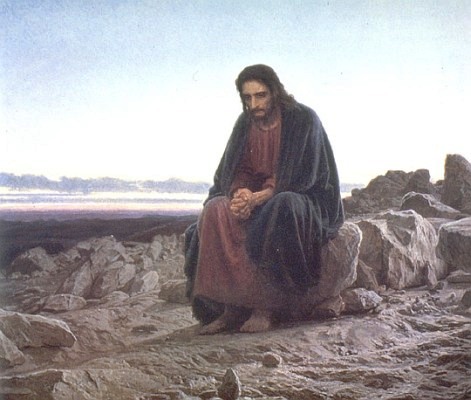
Lent gives us the perfect time to step back and reconnect with Christ's perfect example of enduring a fast and temptation before even making one thought of entering into his public life of the Gospel.  It's such a perfect time that I've swung 180 degrees from a few years ago when the thought of mandating a fast, frankly, was a very big turnoff for me.  Now, it's harder to believe that the Church doesn't require us to fast on more than two days during Lent, let alone the entire liturgical year.  This seems especially true in times like these, when the one-two punch of prayer and fasting are needed to combat the particular crises facing the Church and the world.

But what does it accomplish?


In short, as I wrote about in the previous post, fasting forces us out of the illusion that we can often be tempted to accept, that life is good as long as our temporal needs are satisfied.  It seems to me that there's no coincidence that Lent takes place in the late winter and early spring, at the time when farmers are preparing their fields for the spring and summer crops.  In a similar manner, we are called to "till" the soil of our souls, to allow the Spirit to renew and strengthen the presence of God dwelling and active within us by clearing out all of the "clutter" that life tends to collect inside our minds and hearts.  We have a sublime opportunity to follow the soul's desire for rest and peace in our Exemplar and subjugate to it the body, whose natural desire is just the opposite: for motion and busyness.  As Father Andre Louf noted in his reflection quoted in the February 24th Magnificat,

Want and satisfaction, hunger and satiety, each with its characteristic aspect of pain and pleasure, are constantly alternating.
The more the adult person develops towards the ground of his existence, the deeper the need becomes and the less he is in fact satisfied by the material sustenance served up to him.  The day comes when a hunger and thirst for the living God are born within him and, over and above all earthly existence, are engraved into his body.

So, through fasting, we may begin to re-integrate the desires of the body with the desires of the soul, which all ultimately return to our desire for God.  We align our bodily hunger with our spiritual hunger, and in doing so more perfectly turn our whole self into the grace and peace of the living God.

+AMDG+


Sunday, April 10, 2011

Arrayed for Battle

Alright, it's time to get back after it.  I've taken a few weeks off for a Lenten spiritual "cleaning of house" and examination of priorities, so I wanted to begin again as we enter the last two weeks of Lent by sharing one of the things that I've had some time to reflect upon during time away from blogging.


A couple of weeks ago, I had a chance to listen once again to Peter Kreeft's talk, entitled "Culture War."  It's a 1-hour synopsis of his book of the same title (also summarized in his online article, "The Winning Strategy") and is a stark reminder of what we are called to in life, to enter into the epic battle that has been raging throughout salvation history, beginning in the garden with the first sin of our parents.  Kreeft notes that, to enter this battle prepared requires knowledge of three things: (1) Recognizing that we are at war, and (2) Knowing who it is we are fighting, and (3) being familiar with the weapons at our disposal.  Only after that can we hope to have a chance with picking up our armor and marching faithfully into battle.  St. Paul reminds us starkly in his letter to the Ephesians (6:12) that"we are not contending against flesh and blood, but against the principalities, against the powers, against the world rulers of this present darkness, against the spiritual hosts of wickedness in the heavenly places", and St. Peter further cautions us in his First Letter (5:8-9) to "Be sober, be watchful.  Your adversary the devil prowls around like a roaring lion, seeking someone to devour. Resist him, firm in your faith, knowing that the same experience of suffering is required of your brotherhood throughout the world."

This weekend we had the opportunity to take our Fraternus boys on our third Excursion of the year, where we take a trip and spend time reflecting on the calling and challenge that is handed down to us as Catholic men.  We spent the night onboard the battleship USS Alabama, where they had free reign to explore the ship.  It was an incredible experience for the boys to be able to explore the ship from bow to stern without the confines of a tour, and they had a tremendous time.  What surprised me the most, though, was how much the experience struck me.  I don't think I had ever noticed before just how terribly beautiful a battleship is.  I can't imagine what it must have been like to cruise her and walk the decks when she was fully arrayed for battle.  Guys, you know what I'm talking about.  I was particularly blown away by the way she looked when dawn came and the morning fog began to burn off and her massive 16" guns and towering superstructure emerged from the night mist.  One word came to mind: WOW!  My mind was immediately taken to Song of Songs (6:9), where the bridegroom describes his bride as having the beauty of an army:


Who is she that comes forth as the morning rising, fair as the moon, bright as the sun, terrible as an army set in array?


That is how we, the Church are called to live, as members of an army who stand a firm watch through the night of the "present darkness" or a battleship fully armed for battle.  We have an infinite array of weapons at our disposal, beginning with the virtues of faith, hope, and charity, together with the beautiful and eternally true teachings of the Church, handed down to us through Scripture and Tradition.  These "arms" against the gates of hell culminate in the infinite grace of Sacraments, most especially the body, blood, soul and divinity of Christ himself in the Eucharist.


Armed with this knowledge and Truth incarnate, we must always be vigilant, drilling and training, and ready to engage the enemy who Christ himself described as "a murderer and a thief from the beginning, [who] has nothing to do with the truth because there is no truth in him...a liar and the father of lies." (John 8:44).  Above all, we should strive to model the flawless faithfulness of our Queen of Victory, who leads us in this battle and through whom all the graces that sustain us flow, so that we might appear with her and before him at the end of time, celebrating eternally His victory over sin and death.


Our Lady, Queen of Victory, pray for us!


+AMDG+

Sunday, March 21, 2010

Fasting: Dispelling the Satisfaction Delusion

Then Jesus was led up by the Spirit into the wilderness to be tempted by the devil. He fasted forty days and forty nights, and afterwards he was famished. The tempter came and said to him, "If you are the Son of God, command these stones to become loaves of bread." But he answered, "It is written, 'One does not live by bread alone, but by every word that comes from the mouth of God.'" (Matthew 4:1-4)

I have to begin here with full disclosure: I'm a wimpy faster. There's no two ways around it, I'm not that great at it. Fasting is not fun. When talk comes up of giving anything up that tastes good or that satisfies hunger, mixed feelings well up and I have an overwhelming temptation to turn the other way and high-tail it out. Even the two days of the year that adults in the Church are required to fast, Ash Wednesday and Good Friday, seemed for the longest time like an unnecessary burden; today, though I now understand the purpose behind it, that feeling (temptation) often wins out and, at some point or another I lose resolve. But, even despite many times failing to follow through, the difficulty of fasting has made its power even more evident. I suppose that is what the Lord meant when he replied to St. Paul's appeal for relief of the thorn in his side, "My grace is sufficient for you, for power is made perfect in weakness" (2 Corinthians 12:9)  So, I write this as much for myself as for anyone else.

As a young adult growing up in the Church--when fasting became a requirement--I almost could not believe that we should be required to impose some suffering on ourselves, especially when we had food is readily available. I distinctly remember thinking to myself, "What kind of sense does that make?"

Well, as I've come to discover fifteen years later, it doesn't make any sense--to the world that is. But, then again there are a lot of things that we do as Christians that seem like nonsense to a society that in so many ways is opposed to the Gospel. Christ himself promised that not only would the world not understand us, it would despise and hate us (cf. John 15:18), among other things simply for being counter-cultural and denouncing every idol that society promises will satisfy us. That includes the idea that is thrust in our faces at practically every turn, that having all of our temporal needs met, including the most basic need of food, will ultimately satisfy us.

Joining Christ in the Desert

Back to the physical reality of fasting, again, it is just plain, flat out, not fun. Not only that, but it is difficult. Where I come from, that would seem like a textbook lose-lose situation. By the end of a day of fasting, especially more rigorous fasting, as physical fatigue and hunger headaches start to cloud thoughts, the temptation to give in and give up only gets stronger and stronger. It is hard enough (and I've failed enough) just trying to make it through one day; it is almost unimaginable to have endured for 40. But, in following Jesus' example and allowing the suffering of hunger pangs to take us into an interior desert, we are brought to the reality that it is Christ himself, the new bread of life, that we are now to depend on.

Our Holy Father, Pope Benedict XVI, conveyed this idea well in his book, Jesus of Nazareth, contrasting the Christ's temptation in the desert with his later multiplication of the loaves and fishes: "He himself has become bread for us, and this multiplication of the loaves endures to the end of time." Continuing, quoting the German Jesuit Alfred Delp, who was executed by the Nazis, "'Bread is important, freedom is more important, but most important of all is unbroken fidelity and faithful adoration'" (p. 33). Through fasting, we are prepared for the greater difficulties and temptations that fidelity and faithful adoration to Christ will inevitably bring.

The Holy Father continues,

"We live in this world, where God is not so manifest as tangible things are, but can be sought and found only when the heart sets out on the 'exodus' from 'Egypt.' It is in this world that we are obliged to resist the delusions of false philosophies and to recognize that we do not live by bread alone, by first and foremost by obedience to God's word. Only when this obedience is put into practice does the attitude develop that is also capable of providing bread for all" (p.34)

Fasting pulls us away from that 'satisfaction delusion' offered by this world and back into the eternal reality, to join Christ in the desert and, with him and in him, to submit our will to be steeled against the lies of the tempter. It allows us to rediscover the truth that the only thing that can satisfy us is the Word of God, whom we have the privilege of knowing as the person of Christ and experiencing in the flesh every time we celebrate the Eucharist.

To the Foot of the Cross

By fasting, we voluntarily impose suffering on ourselves and, in doing so, we allow our focus to be pulled away from our 'this world, here-and-now' comfort zone, straight back to the foot of the cross. It hastens our death to self, so that being emptied as he was, we can better dispose our will to his and, with greater focus and purpose, carry out the mission that has been given to us of spreading the Gospel. It gives us a stark reminder, through a real and tangible pain in our stomach, that to join in the joy of his work and ultimately the glory of his Resurrection, we must first endure the suffering, and pain of our crosses in life, and ultimately the death that he has transformed into a door to eternal life.

Prayer Booster

In Mark 9, after Jesus drove an evil spirit out of a boy, his disciples asked him, "'Why could we not cast it out? He said, 'This kind can only come out through prayer'" (other ancient translations add and fasting; Mark 9:28-29, NRSV). It would seem that Jesus is trying to make a point here, first about the necessity of prayer, and second that there are certain, powerful actions that ordinary, 'run-of-the-mill' day-to-day faithful living cannot by itself bring about. In order to reach this more powerful, higher level of faith in action, we must first enter more deeply into the mystery of prayer, by denying the needs of our physical body (albeit temporarily).  Even better, we should strive more frequently to enter into this self-denying faith.  For most of us, who otherwise have our bodily needs met, this is accomplished by fasting. In doing so our spiritual needs, both our individual needs and those of the of the faith community as a whole, are brought into clearer focus as we bring them closer to Christ by drawing nearer to his cross.

On second thought, those two days probably aren't enough.

Saturday, February 27, 2010

The Pharisee vs. the Tax Collector

After last week's post about Father Delp's reflection on the call of Matthew in Luke 5, I came across another "tax collector" reflection while re-reading Pope Benedict XVI's Jesus of Nazareth.  This time the reflection focused on the parable told by Jesus' parable of the Pharisee and the tax collector (Lk 19:9-14):
He also told this parable to some who trusted in themselves that they were righteous and regarded others with contempt: "Two men went up to the temple to pray, one a Pharisee and the other a tax collector.  The Parisee, standing by himself, was praying thus, 'God I thank you that I am not like the other people: theives, rogues, adulterers, or even like this tax collector.  I fast twice a week; I give a tenth of all my income.'  But the tax collector, standing far off, would not even look up to heaven, but was beating his breast and saying, 'God, be merciful to me, a sinner!'  I tell you, this man went down to his home justified rather than the other; for all who exalt themselves will be humbled, but all who humble themselves will be exalted.  
I don't know why, but I seem to be brought back to Luke's focus on Jesus' call and relationship with the tax collector, whether it be the specific, individual call of Matthew to follow him in righteousness, or this contrast with the Pharisee.  One thing I've learned is that when the Spirit leads you to water, it behooves you to follow and drink.  And so I will with this; the humility and repentance of the tax collector makes a perfect and convenient point of reflection for the rest of Lent.

In Chapter Four (p. 61-62) of Jesus of Nazareth, the Holy Father elaborates on Jesus' contrast:
The real point is...that there are two ways of relating to God and to oneself.  The Pharisee does not really look at God at all, but only at himself; he does not really need God, because he does everything right by himself.  He has no real relation to God, who is ultimately superfluous - what he does himself is enough.  Man makes himself righteous.  The tax collector, by contrast, sees himself in the light of God.  He has looked toward God, and in the process his eyes have been opened to see himself.  So he knows that he needs God and that he lives by God's goodness, which he cannot force God to give him and which he cannot procure for himself.  He knows that he needs mercy and so he will learn from God's mercy to become merciful himself, and thereby to become like God.  He draws life from being-in-relation, from receiving all as gift; he will always need the gift of goodness, of forgiveness, but in receiving it he will always learn to pass the gift on to others.  The grace for which he prays does not dispense him from ethics.  It is what makes him truly good in the first place.  He needs God, and because he recognizes that, he begins through God's goodness to become good himself.
How often to we who call ourselves believers walk around in our daily lives looking outwardly at others, subtly (or not so subtly) judging them by our standards, all the while thinking like the Pharisee and thanking God that we are not "like them"?  For the rest of Lent - and beyond - I for one know that I need to focus more inwardly on returning to the humility of the tax collector.  It will not be a one-time, 180-degree turn.  If we think that we can turn toward Christ and then march through life and approach the throne of grace because we are "good enough," we grossly deceive ourselves and are in a freefall directly into Satan's trap.  Instead, we need to fall on our faces in shame and daily - even hourly and in every encounter with others - remind ourselves that it was for us, not just for them, that he had to hang there and die.  This is what our Lenten sacrifices should be about, not giving something up for the sake of making ourselves better, but rather emptying ourselves of our own temporal comfort and satisfaction to remember how desperately we need to approach the cross.  Approaching and embracing that cross will inevitably shake us out of any false sense of material comfort and self-righteousness, but is the only way for us to share in the gift of resurrection that comes at Easter.

Sunday, February 21, 2010

The Setting Free of Matthew

February 20th's Magnificat reflection (Vol. 11, No. 13, p. 289) on the Gospel reading from Luke 5 (27-32) offered a striking commentary on the nature of true human freedom that puts a worldly sense of freedom back in its proper perspective; namely, that true human freedom lies in nothing more and nothing less than hearing and answering Christ's call to "follow me" (5:27).
Humans need freedom.  As slaves, fettered and confined, they are bound to deteriorate.  We have spent a great deal of thought and time on external freedom; we have made serious efforts to secure our personal liberty and yet we have lost it again and again.  The worst thing is that eventually humans come to accept the state of bondage - it becomes habitual and they hardly notice it.  The most abject slaves can be made to believe that the condition in which they are actually held is freedom.
During these long weeks of confinement I have learned by personal experience that a person is truly lost, is the victim of circumstances and oppression only when he is incapable of a great inner sense of depth and freedom.  Anyone whose natural element is not an atmosphere of freedom, unassailable and unshakable whatever force may be put on it, is already lost; but such a person is not really a human being anymore; he is merely an object, a number, a voting paper.  And the inner freedom can only be attained if we have discovered the means of widening our own horizons.  We must progress and grow, we must mount above our own limitations.  It can be done; the driving force is the inner urge to conquer whose very existence shows that human nature is fundamentally designed for this expansion.  A rebel, after all, can be trained to be a decent citizen, but an idler and a dreamer is a hopeless proposition.
Human freedom is born in the moment of our contact with God.  It is really unimportant whether God forces us out of our limits by the sheer distress of much suffering, coaxes us with visions of beauty and truth, or pricks us into action by the endless hunger and thirst for righteousness that possess our soul.  What really matters is the fact that we are called and we must be sufficiently awake to hear the call.
                                                                                                         Fr. Alfred Delp, S.J.


Father Delp (+1945) was condemned to death in Germany during WWII.

Matthew discovered the opportunity for true freedom in Jesus' call, and immediately left everything behind, got up and followed Him (cf Lk 5:28).  Lent presents us with a unique opportunity for us to reaffirm our commitment to the same; to separate ourselves from the world, reflect on our own Baptism and repentance, and figure out where we can improve in our walk as children of God.  It's our chance to rediscover and renew our sense of freedom from everything in our lives - including our very selves - that holds us back from responding fully and completely to Christ's call, and to remember that to choose anything less than him leaves us only as hopeless, empty slaves.