Showing posts with label obedience. Show all posts

Sunday, December 1, 2013

It's Advent: Don't Trust Your Feelings - NCRegister


Advent begins today, the time of anticipation and "mak[ing] straight in the desert a highway for our God." (Is. 40:3).  Time for some deeper spiritual examination, confession and pulling out all the old stumps of our pet sins and spiritual weaknesses that we let hang around because we're just too lazy (I use that pointed word for my own sake) to rout them out and really smooth the plain for Christ to come into our lives--and the world through us--and do his work.

This article reminded me of that, and one particular hit me like a ton of bricks, since I've been trying to moderate my diet better, and fast for specific intentions:


Do you control your appetites or vice versa? You want to be moderate in what you eat or drink. You occasionally even make a significant sacrifice in this area. But does it happen even more often that you rationalize and break your own rule? Look at the facts: How many sweets or sodas or glasses of wine did you consume yesterday? This week?


I guess it's time to get on board with Yoda's "Do or do not, there is no try."

Read more: It's Advent: Don't Trust Your Feelings - NCRegister

Sunday, October 13, 2013

The Five W's

Actually, it's the four "W's" plus "H."  It's a generic format of questioning that I've always found useful when beginning to look into the facts of a matter, whether it's deciding what I've got to do around the house or answering a question at work.  It's a tool that stuck with me from my early days in the military, and continues to prove useful to this day; whenever there is a question to be answered or a basic report to be given, make sure that at least the "five W's" are covered.

1. Who?
2. What?
3. Why?
4. When?
5. How?

I don't know why it never occurred to me earlier, that this same basic method of questioning might prove to be just as good at kicking off a good, basic spiritual exercise (I've been overdue for one) as it is at answering the pragmatic issues that come to us in day to day life.  After all, in the end, what is more pragmatic than our relationship with Christ and his Church, from which all else that is true, good, and beautiful, flows?

So, in the next few weeks, check back for a short series of posts, where I'll share my basic thoughts on the answers to five basic question of the faith:

1. Who do I believe?
2. What do I believe?
3. Why do I believe?
4. When do I believe (i.e., when is my faith called into action)?
5. How do I believe (how do I surrender to the faith, and how is that faith supposed to be demonstrated)?

No heavy stuff, no fluff (not a lot anyway).  Just a pure, unadulterated, back-to-basics spiritual exercise to till the soil a bit...and get me back on a regular blogging.

+AMDG+


Sunday, June 2, 2013

Gods and Goddesses

While life has been happening, this blog has not.  In the last few months, we have:

  • Left behind 10 years of the familiarity of military life
  • Moved half way across the country (to be closer to L's family)
  • Begun a new career
and...I've let all of that get in the way of the nudging I've been feeling to "get back after it."

I'm not sure exactly what direction that nudging will take at this period of our lives, but how often do we when we begin down one of those forks in the road, be they large or small?

So, I guess the long and short of it is, we'll see.

Separately, another "nudge" recently came in response to my prayer for help and clarity in dealing with a couple of difficult situations that have arisen at work.  While there hasn't been a crystal clear, lightning-bolt-from-the-heavens answer (again, how often does that happen?), I was prompted to pick up a book that Dr. Peter Kreeft published a couple of decades ago and mentioned after a recent talk was his favorite: Heaven: The Heart's Deepest Longing.

I'm only half way through it, but it has reminded me of the desperate need to spend significant, dedicated time in contemplative prayer--particularly adoration--and spiritual reading, both of which I had been neglecting.  Contemplative prayer is the time when the Lord speaks to our heart, sometimes in whispers and sometimes more.  It is the time when he feeds us mentally and reminds us of His perspective on things when we can so easily get lost in our own corner of the world.  Most importantly (for me, at least), it's the time among the beautiful, busy times of family life, work, relationships, and everything in between, when He reminds us who we are--sons and daughters of God, co-heirs with Christ, destined for a share of his divine, eternal life beyond our wildest imaginings.  This contemplation goes beyond the "be still and know that I am God" moments that are completely necessary; we can carry it with us into the moments of our daily lives to allow him to speak the peace and perspective into all of them, ordinary or chaotic.

Dr. Kreeft shares an excerpt from C.S. Lewis' The Weight of Glory that his this home point-blank:

It is a serious thing to live in a society of possible gods and goddesses, to remember that the dullest and most uninteresting person you can talk to may one day be a creature which, if you saw it now, you would be strongly tempted to worship, or else a horror and a corruption such as you now meet, if at all, only in a nightmare.  All day long we are, in some degree, helping each other to one or the other of these destinations...There are no ordinary people.  You have never talked to a mere mortal.  Nations, cultures, arts, civilisations--these are mortal, and their life is to our as the life of a gnat.  But it is immortals whom we joke with, work with, marry, snub, and exploit--immortal horrors or everlasting splendours.

Wow! count on C.S. Lewis (and Dr. Kreeft) to give a little of that contemplative perspective.  God speaks to us, and counts on us to speak to us and love each other into relationship with Him.  What an awesome responsibility; unfortunately, one that we so often let life and the lure of the world get in the way of, but that he is ever faithful about gently nudging us back to.

+AMDG+

Saturday, December 15, 2012

Renmant Theology and the Church Today

More and more frequently, thoughts inquiring into the mind of God and how he will seek to purify the cancers of dissent and relativism from his Church seem to be entering more and more into my prayer and meditation.  Many a day, in response to encounters and events epitomized by the fact that our current President, perhaps the most anti-life that we have ever seen, won the Catholic vote by 51% to 48%, I cannot help but pray, "How long, Lord, will you allow this to continue, where your people who profess to believe in you and serve you--who claim to be your body--serve you with their lips but keep their hearts far from you?" (cf Mt 15:8).  Why do the numbers of the faithful continue to decline, despite the fact that we live in a world that seems increasingly dominated by hostility to Christ and his message (as the Master himself promised it would be)? Why are we failing in swaying people away from a world that offers so much yet constantly fails to deliver and can make no assurances about eternity?

In his wonderful blog that I just discovered, Monsignor Charles Pope has offered some practical insights on this question (admittedly his own thoughts and reflections, not necessarily the dogmatic teachings of the Church).  He offers them in the context of a term that I had never heard before reading his post, Remnant Theology.  Remnant Theology reflects on the history of God and his people (first Israel, now the Church founded on Christ) from the perspective that he has time and again allowed his people to be led into exile and persecution, to remove the slough of complacency, compromise with evil, and sometimes downright disobedience and dissent that has crept in over time and distanced them from complete dependence on him.

What does Remnant Theology have to teach us about the Church Today?

His conclusion is both challenging and encouraging, echoing Christ's command to those gathered as he ascended into heaven:

Frankly it is going to take a stronger and purer Church to endure the cultural tsunami that is and has been rolling in. The first waves hit in the late 60s, and successive waves look to be even more destructive as Western culture is gradually being swept away. The Church will have to be pure and strong to endure the days ahead, to rescue those we can, and to help rebuild when the terrible waves have worked their last destruction.
I realize this post will not be without controversy. I do not propose it as the only answer to the times. Neither do I claim that fallen-away Catholics have simply been pruned as though we could know they will never return and be grafted on again. We should continue to Evangelize and seek to grow the Church by Christ’s own mandate. We cannot know the size the Lord wants us to be nor should we ever stifle the Spirit of Christ’s mandate, Go and make disciples of all the nations….
+AMDG+


Monday, March 19, 2012

Saint Joseph and Rendering Unto Caesar

"Saint Joseph with the Infant Jesus," Guido Reni (c. 1635)
Today' is the feast of St Joseph, one of my personal favorite saints to whom I am devoted as the model father, leader, and guider of the Holy Family during Christ's childhood.

Today, as I was looking for some good reading about St Joseph, I came across it in what was, frankly, the least expected of places, the headlines at The New American (which is quickly becoming one of my favorite pro-Christian, pro-liberty news outlets).  The article, written by Jack Kenny, summarizes the lessons that we Christians can learn from the model of Saint Joseph about rendering unto Caesar what is Caesar's (our obedience to just laws and statutes) and to God what is God's (our whole selves, made in his image and likeness).

Joseph was much more than just the strong, silent, and righteous foster father of Christ; he was also the model of what it means to be a statesman and keep the proper priority in lending our allegiances.

Saint Joseph and the Rendering Unto Caesar.

+AMDG+

Monday, October 24, 2011

Here and Now

This past week, I had the chance to meet a new friend for lunch, who I already don't get to hang out with enough.  As we got to talking before we even had a chance to order, we discussed all matter of "guy" things--our families, business, promotions, plans for our families to move toward more sustainable living.  That discussion led me to ask a question that's been on my mind lately as we contemplate the next chapter in our lives:

How far is too far when it comes to making long-term family plans?  Where do we cross the line between setting goals for our family (location, lifestyle, etc) and grasping at the future?  What is the point where we go from setting necessary and realistic goals--both as individuals and families--to being untrusting of God and his plan for our future?

My friend so kindly reminded me that God used the very particular language, "I AM," (Exodus 3:14) to refer to Himself when Moses inquired how he should refer to God when the people start asking about his encounter.

With that title, God placed himself squarely in the present.  He did not say, "I was," I will be," "I have been, am today, and will be," or any other tense.  He simply said, "I am."  With that, he came as Emmanuel, God with us, here and now, and in every moment from the present into eternity.  Christ continued this use of the present "I am" in his last words to his disciples before ascending back into heaven:

"...and behold, I am with you always, to the close of the age." (Matthew 28:20)


Even with his parting words, he remains with us, body, blood, soul, and divinity, in the Eucharist and in the body of the Church, inviting us time after time to let go trust him with all the details of our life as he commanded us to do earlier in Matthew, 6:25:

"Therefore I tell you, do not be anxious about your life, what you shall eat or what you shall drink, nor about your body, what you shall put on."


As a man who, like other men, is hard-wired to protect and provide for his family, I've decided to wrestle some more with this one.  So, I'd like to start this small discernment by asking you all:

Where is the "line in the sand" between looking out and planning for the temporal good of our family but also trusting God and remaining in the present?  How is a parent--especially a husband and father--called to balance the two?  Or do they need to be balanced at all?


I really, sincerely would like to know what you think, and any tips you might have for maintaining the balance.

Thanks!

+AMDG+

Monday, October 10, 2011

Another Bishop's Warning

Bishop Samuel Aquila of Fargo, ND
Another Bishop is stepping forward to give caution, but Bishop Aquila's seems to be more directed at Catholics, letting us know that the time is at hand for us to step out of the comfort of the boat into the storm of the cultural war that Christ has put us here and now to fight.


+AMDG+

Saturday, October 8, 2011

Article: It Is Dangerous to be Right When the Government is Wrong

Yesterday, Judge Andrew Napolitano, of Fox News fame, published an article on Natural Law as a primer to his upcoming book of the same title, "It Is Dangerous to be Right When the Government is Wrong: The Case for Personal Freedom".  If the title looks familiar, it's because it is a quote by the 18th Century French philosopher Voltaire

In the article, The Judge draws together, with his usual wit and pragmatic examples, the relationship between Natural Law, Human Law, and the danger that lies in the movement we have seen recently to uproot the entire system (which has led to the most prosperous and free socio-economic system on earth) and replace it with the tried, tested, and failed political philosophy of Positivism.

Judge Nap concludes at the end of the article (bolded emphasis mine):

Although we have explored at length how man-made law must be subject to the Natural Law, perhaps the best indication of the falsehood of Positivism is that, deep down, we know that the transgression of our natural rights is wrong. We do not simply disagree with it, but feel a sense of visceral outrage that one human would try to treat us as inferior and subject to his will; it is antithetical to our selfhood. Thus it is in our human nature not just to yearn for freedom, but to recognize when those yearnings are unnaturally restricted. Elsewhere, V referenced Thomas Jefferson when he stated that "people should not be afraid of their governments. Governments should be afraid of their people." It should be clear that Positivism’s scheme of law relies upon the people obeying laws because they are afraid of the government, not because those laws are in accord with the Natural Law, and therefore just.
If we are to live forever in a legal system founded on Positivism, then we can only hope that we will have laws which, coincidentally, happen to be just. But there is another way, the way of the Natural Law: Rather than be content to follow the will of the truncheon, we can choose to listen to those words which enunciate truth, and our Founders’ promise that those truths will not be denied by government.
This book is about the titanic battle between adherents of Positivism and believers in the Natural Law; stated differently, between Big Government and individuals. As we shall see, the danger that befalls individuals inevitably comes from the government. The government makes it dangerous for us to be right when it is wrong.
Click here to read the full article at lewrockwell.com.


I look forward to reading his book and am going to get started on a post on the dangers of Positivism from the Catholic Perspective, which it seems the U.S. Bishops are just starting to wake up to.


+AMDG+

Wednesday, September 21, 2011

Wednesday Quick Thought: Be Catholic!

I don't want to start off with a downer after a couple of weeks away, but last Friday's episode of the Vortex reminded me of a stark reality that's so easy to forget when I get into a spiritual and physical "comfort zone."  By all indicators, Western civilization, the society founded upon centuries of Christendom, is coming apart at the seams.  Even more than that, it seems as though the very foundations are crumbling, precisely because we have turned our back on God, and it is as though we are headed into another dark ages. Even Pope Benedict highlighted the stark reality in his Christmas address to the Roman Curia last year.

So what are we to do about it?  The short answer is...


Be Catholic!!!

Live as Jesus Christ has called us to live.  Be willing to stand up for what you believe and, more importantly, the Truth Incarnate as he has revealed himself to us in the Church.  We do not know where this will lead in terms of history, but we are beloved children of an infinitely loving Father and brothers and sisters given assurance of eternal joy beyond imagining by our Divine King and Brother.  We live with the sure knowledge that "everything works together for good for those who love the Lord" (Romans 8:28), and have received the explicit command to "Be Not Afraid" (cf Isaiah 41:10, Matthew 14:27).


This program is from RealCatholicTV.com

+AMDG+

Saturday, August 20, 2011

Values in A Time of Upheaval Part Three: Who Needs Guilt?


In Chapter Five of Values in a Time of Upheaval, entitled "If You Want Peace..." the Holy Father begins by introducing two opposing concepts of morality, and the journey that brought him to the Christian understanding of how our conscience must function to create peace within our souls and peace within the world.

Morality of Conscience

The first view of morality holds that conscience is the highest rule, that the fundamental system of accountability in safeguarding human freedom lies in following our own conscience, even when it leads us to oppose authority.  According to this view, conscience ultimately has the last word.  Some even take this so far as to believe that a person cannot go wrong by following their conscience, that conscience is infallible.

Obviously there is some truth to this--we are accountable first and foremost to ourselves--but to argue that the ultimate accountability is to our conscience is just plain wrong.  Our whole person, including our conscience, is subject to the distorting effects of sin.  This is dangerous because it ultimately only leads us back to into our fallen, broken selves, and closes any window that allows us to see the "Other," the Truth that unifies all things.  In that system, the truth about anything becomes subjective and individual instead of objective and universal.
"One must always follow a clear verdict of conscience....But it is quite a different matter to assume that the verdict of conscience...is always correct, i.e. infallible--for if that were so, it would mean that there is no truth, at least in matters of morality and religion, which are the foundations of our very existence...there would exist only the truth of the subject."
Isn't this view, what Pope Benedict refers to as" the idea of conscience found in liberalism," precisely what we see prevailing in our world today? This is exactly what leads to the phenomenon the Holy Father has referred to as the "dictatorship of relativism."  On the surface, its initial promise, that it would "enable human beings to live together" in peace, without our conflicting views rubbing up against each other, seems tantalizing.  But this quickly comes to an end where it meets the reality of the darkness that remains in the human soul.  We have seen examples of this time after time in history, and what seems to be almost weekly in the news headlines, of the terrible consequences when this darkness festers and erupts into the world in violent, often murderous, action.  If this darkness is not exposed (often painfully) to the outside light, it remains with nothing to quell it, twisting conscience more and more until the conscience itself becomes unrecognizable. Under this idea, even the worst mass murderer would be justified in his actions if, in the deepest part of himself, he believed that what he was doing was right.

So what is the antidote?  In one word: guilt. In a few more words, a properly formed conscience that guilt leads us to recognize we need.

Morality of Authority


This opposing view of morality of conscience argues that, basically, our conscience is fallible and needs help from outside (or, above).  The conscience can be led into error and distorted, and so it is not reliable as a final source of moral authority.  It forces us to look outside ourselves for another, authoritative source.  When we allow the darkness and sin within us to be exposed to that outside source of light, it creates a feeling that is painful, often deeply so.  It's like a cancer being exposed to radiation treatment, but in this case the "radiation" is Divine.  The pain that comes each time the cancer festers and is exposed to light is guilt.  Guilt comes when we recognize the difference between who we are and who we ought to be, and destroys any false notion of the conscience as absolute.  The Holy Father reflects upon this idea of guilt as he first came upon it in an essay by German psychologist Albert Gorres:
"The guilt feeling that shatters a conscience's false claim and the criticism made by my conscience of my self-satisfied existence are signals that we need just as much as we need the physical pain that lets us know our normal vital functions have been disturbed.  One who is no longer capable of seeing his own guilt is psychologically ill..."
Guilt is what sounds the alarm bells that something within us has violated our conscience, but more importantly has violated the objective Truth that conscience is designed to remind us of.  Guilt gives us the ability to look inwardly and realize that, for whatever reason, we have closed the window on that cleansing light, even if momentarily, and allowed the cancerous growth of sin to start accumulating again.  The Pope continues, "Jesus can work effectively among sinners because they have not become inaccessible behind the screen of an erring conscience, which would put them out of reach of the changes that God awaits from them--and from us." This is why, in the parable of the Pharisee and the tax collector (Luke 18:9-14), "the tax collector with all his undisputed sins is more righteous in the eyes of God than the Pharisee with all his genuinely good deeds."


The world today, which in so very many places subscribes to the morality of conscience, would have us believe that guilt is a bad thing, something to be done away with. "We have lost sight of truth as such, the absolute, the basic point of reference of our thought," the Holy Father says,  "and this is why...there is no longer any 'up' or 'down.'" There are no directions in a world that lacks fixed points for measuring."  In reality, guilt is absolutely necessary for our proper spiritual and psychological functioning.   We need it to let us know when the compass of our conscience is not working as it should, or that, if it is properly formed, we have disregarded it and allowed ourselves to be deceived that East, West, or South are North.

This all leads to the question of where we can turn to make sure that our conscience works the way it should.  To what--or, to who--can we can look to find the source of cleansing and healing that the Psalmist begs for in Psalm 19:12: "But who can discern his errors? Clear thou me from hidden faults"?  That, and the "working examples" of the saints, whose lives are lived and whose example lives on for us as benchmarks of properly formed conscience, will have to wait for another post.

In the meantime, please pray for the Holy Father, that he will continue to be blessed with grace and strength as he leads the Church to remain a beacon of light in a world of darkness.


+AMDG+

Monday, August 15, 2011

"If You Want Peace..." A Primer

This past week in Britain, and in several less-reported instances in locations across the United States, we have seen the outbreak of violence from a generation of teens and twenty-somethings who, whatever their motivation, had no excuse for wreaking the violence and destruction that they did.  As I sat, browsing news article after news article, each offering a different slant on the unfolding situation and playing the "blame game," I couldn't help but try to probe each perspective looking for a common thread.  Surely, there must be something to explain why all of this pent-up (fill in the motivation) was coming to a head and finding its expression in such senseless violence against fellow citizens, their property, and their livelihoods.

It did not take much longer to figure out what drove them, or better, what did not restrain them from lashing out: a sheer, unadulterated lack of conscience.  Max Hastings put it perfectly in his August 10 U.K. Daily Mail article, "Years of liberal dogma have spawned a generation of amoral, uneducated, welfare dependent, brutalised youngsters," when he said:

"They are essentially wild beasts. I use that phrase advisedly, because it seems appropriate to young people bereft of the discipline that might make them employable; of the conscience that distinguishes between right and wrong.
They respond only to instinctive animal impulses — to eat and drink, have sex, seize or destroy the accessible property of others."
Where are these rioters' consciences?  Did it not cross one of their minds that acting this way--invoking chaos and destruction--is evil no matter what the supposed justification?  Had they no shame?


Sadly, for many of them, the short answer is no. Growing up in an entitlement, me-me-me, I-I-I, now-now-now culture, many--even those who did not want for anything and had promising futures--either never had theirs properly formed to begin with or, worse, checked them at the door when they decided to step foot into the street.

This topic of conscience and the questions that follow from it are exactly what the Holy Father tackles in Chaper 5 of Values in a Time of Upheaval, an essay entitled If You Want Peace...: Conscience and Truth.

What is our conscience?

How does it function?

What is its purpose, both within our individual self and in the whole of human society?


What is our responsibility to obey and to form our conscience?

Look later this week for an unfolding of the Pope's discussion as he explores and probes the answers to these questions and more in If You Want Peace.

Until then...

+ AMDG+

Wednesday, July 13, 2011

Wednesday Quick Thought: Sails in the Wind

According to the Baltimore Catechism, we were created to know, love, and serve God.  To expand on that a little, we were created first to glorify him by loving him with all of our being, and to transmit his love into the world by being living reflections of that love.

To live any other way, that is, apart or distant from God, is to be like a sail that is furled and stored.  Before it is hoisted to catch the wind, it is a useless, sometimes rather heavy piece of fabric.  But once it is unfurled into the power of the wind, it becomes an incredible instrument of propulsion, able to move massive vessels over great distances and high speeds.

Our souls, like sails, are meant to operate and transmit the power of God's love into our world.  So long as we cooperate and "unfurl" our hearts, minds, souls, and bodies to him, there is no limit to what he can accomplish with us.

+AMDG+

Sunday, February 20, 2011

Do You Love Me?

Do you wake up in the morning, longing to spend a day in his service?  Do you go to bed at night longing for the time that your exile on this earth will come to an end, he will welcome you into our eternal home, to be face to face with him, sharing in the unimaginable bliss and glory of his divine life, forever?  Are you so enthralled with him that his name--the name above all names--is always on the tip of your lips and you cannot help but tell others about him?

I found myself asking that question recently, on the occasion of a (very) rare morning where I did happen to wake up in that state of mind.  The reality, sadly, is that 90% the answer is no, I don't or no I'm not.  I wish it were yes, but I'm not quite there yet.  There are many days that I wake up with a thousand other things on my mind.  I've got a to-do list that's a page long before I even start writing it down, and the last thing I want to do is spend time in prayer and scripture, "being still and knowing that [he is] God."  Deep down inside though, I know that is what I need the most.  I need Him. No, more than that.  I need him as the center of my life, the center of my existence.  I want to be completely, achingly in love with him.  Sometimes I literally have to stop myself in my tracks, before being drawn into the morning routine, and force myself to sit down, like a child, to let that reality sink in.

The closing paragraphs of the Gospel of John, 10:15-19, contain a very powerful encounter between the risen Jesus and Peter, that show us the kind of love that Christ calls us to:

When they had finished breakfast, Jesus said to Simon Peter, "Simon son of John, do you love me more than these?"  He said to him, "Yes Lord; you know that I love you."  Jesus said to him, "Feed my lambs."  A second time he said to him, "Simon son of John, do you love me?"  He said to him, "Yes, Lord; you know that I love you." Jesus said to him, "Tend my sheep."  He said to him the third time, "Simon son of John, do you love me?"  And he said to him, "Lord, you know everything; you know that I love you." Jesus said to him, "Feed my sheep.  Very truly, I tell you, when you were younger, you used to fasten your own belt to go wherever you wished.  But when you grow old, you will stretch out your hands, and someone else will fasten a belt around you and take you where you do not wish to go." (He said this to indicate the kind of death by which he would glorify God.)  After this he said to him, "Follow me."

Three times Jesus asks Peter, "Do you love me?"  And with each reply that Jesus leads him to, Peter affirms what he denied as Christ was enduring the trial of his Passion.  But why three times?  Wouldn't Jesus be satisfied with one sincere, heartfelt affirmation of Peter's love?  That's where a key subtlety of this passage, that is lost in translation, comes into play.

In the original Greek, there are three types of love: agape (unconditional love), filia (brotherly love), and eros (passionate love, as between lovers).  God, who is Love, encompasses all three, but here specifically challenges Peter to the highest and most difficult of the three: agape.   He asks Peter, "Do you agape me?"  That is, do you love me unconditionally?  Would you go anywhere and do anything for me?  Would you spare nothing, even your own life, for my sake?  Peter, even having witnessed Christ's Passion, death, and Resurrection, still does not quite comprehend what is being asked of him.  He replies, "Yes, Lord; you know that I filia you."  I love you like a brother.  Jesus challenges Peter a second time, probing deeper, "...do you agape me?"  Again, Peter either does not comprehend or cannot allow himself, because of the sin-weakened will that we all have, to go that far.   Still, with each reply, Jesus challenges Peter to do his work.  He loves Peter so much--unconditionally--that he trusts him, a sinful man, to take up his work of building the kingdom.

Jesus asks Peter a third time, but this time his question is different.  Just as he did in descending from Heaven to live and die to redeem us, in the third challenge Jesus lowers himself to Peter's level: "Peter, do you filia me?"  This third time, Peter replies the same way, but Jesus follows with a promise, "...you will stretch out your hands, and someone else will fasten a belt around you and take you where you do not wish to go."  This promise is a foreshadowing of Peter's martyrdom, but more importantly, it is a testimony that he will learn to love unconditionally, even though he is not capable of doing so right now.  His martyrdom will be the ultimate testimony of that love.   He will be fully redeemed.


Jesus asks the same of us today, "Do you agape me?"  Are you willing to give your life for me?  Even if it is not by shedding blood, will you give up your daily comforts, preferences, and anything in your life that distracts your gaze from me?  Will you deny yourself, sacrifice your own happiness and pleasure and use your time and energy to serve me by serving others?  I for one am more like Peter in this passage than Peter being led to his martyrdom.  But I also cling to the promise that he made to Peter and that he makes real by coming down to us and giving us himself--body, blood, soul, and divinity--in the Eucharist and in the Sacramental life of the Church.  By the power of his Spirit, he slowly but surely is making his agape fully alive and active in us.  He is giving us the promise and gift of his eternal life and unconditional love, so that we might learn to live and love in the same way, so that in the end we might say with the eternal life he has given us, "Yes Lord, you know that I love you."


+AMDG+

Saturday, January 22, 2011

Faith and Firearms, Part 2: Legitimate Authority

Part 1 of this series ended with section 2265 of the Catechism:


2265  Legitimate defense can be not only a right but a grave duty for one who is responsible for the lives of others.  The defense of the common good requires that an unjust aggressor be rendered unable to cause harm.  For this reason, those who legitimately hold authority also have the right to use arms to repel aggressors against the civil community entrusted to their responsibility.


So, anyone who holds legitimate authority has "not only a right, but a grave duty" to protect the lives of those they are responsible for.  So, what does "those who legitimately hold authority" mean?  Does that mean ourselves?  Local law enforcement (police)?  The government?  Well, according to the natural law, yes, yes, and yes.


Authority and responsibility go hand-in-hand.  The most basic unit of the "civil community" is the family and, until recently, it has been broadly accepted across demographics, cultures, and faith traditions that the husband and father, as the head of the household (in case anyone has any questions about what this means from the Christian perspective, see Ephesians 5:25), holds the responsibility to serve, provide for and protect the family.  This is certainly not to say that the wife/mother and children are not capable of defending the family, but the primary responsibility--the responsibility to lay down his life--falls squarely on the shoulders of the father.  If we accept that the father holds the ultimate responsibility within the family--that God has entrusted them to his care--then he (and certainly the wife and mother, if he is not present) has a right and a "grave duty" to repel aggressors against it, using arms if necessary.


A common retort is, "Those rules don't apply anymore.  We have enough police now that are only a 911 call away."


Well, true, the police will usually come if you call 911, but (depending on the city) the average time for responding to a priority 1 call (a life-threatening situation) is 7-10 minutes.  According to the Justice Department's 2005 Report of Criminal Victimization in the United States, in 71.1% of violent crimes, it took law enforcement more than 5 minutes to respond. Smaller, local departments may be able to respond more quickly, but even as we saw in the case of the 2009 Fort Hood shooting, where Sgt Kimberly Munley arrived on scene within a matter of minutes to heroically stop Nadal Hassan, his damage--13 dead and 38 others wounded--had already been done.  As the saying goes, "the police are only minutes away when seconds count."  This is certainly not meant to be a ding on police officers who put their lives on the line day in and day out, only an acknowledgement of the reality that they cannot be everywhere and at all times.  As a note, according to 2007 U.S. Justice Department Statistics, there are 463,000 sworn officers in the various jurisdictions within the U.S. Assuming three 8-hour shifts per day, that leaves 154,000 officers on duty for a national population of 300 million.  In other words, there is approximately one officer on duty for every 2,000 citizens.  It may feel like they're going to be there right away, until you're the one that needs them there right away.


There is more to it than just the time aspect.  The Supreme Court has ruled consistently (over ten separate times, in fact, including 1981's Warren vs. District of Columbia, 1989's DeShaney v. Winnebago County, and most recently in 2005 Castle Rock v. Gonzalezthat, despite the common motto, "to protect and serve," police do not have a sworn obligation to protect individuals.  If they did, citizens would have legal--and possibly criminal--recourse against police for not saving the lives that depended on their action.  Their primary and only constitutional responsibility is to enforce the law and, by doing so, to maintain the order of society at large.  More often than not, that means prioritizing their limited resources and apprehending those suspected of violent crime after the fact so that the can be brought to trial.  Individual incidents of violent crime--particularly crime against law-abiding citizens--generally cannot be dealt with beforehand by police because before the crime has taken place...no crime has taken place.


So, the police cannot respond instantaneously to protect us, and cannot respond to a crime until its commission has begun to unfold.  In that gap until they can, and in as much as we can anticipate potential crimes through awareness of our surroundings and circumstances, the legitimate authority for defense defaults to the individuals who are present.  In a situation where the threat is against the family, that responsibility falls primarily on the father.


Again, as I stressed in Part 1, the decision to keep and bear arms in the form of firearms--as is our Constitutionally-protected right--is a very personal one.  But should the worst happen, I for one want to be prepared to respond to any predator who threatens the life of physical well-being of my family with whatever amount of force is necessary to stop them.  If I can help it, and cannot convince them that harming my family is not in their best interest, I would prefer to keep that fight beyond arms' reach, and firearms are the logical tools that allow me to do that.


Look for next week's return from the practical to the philosophical, as I'll explore in more depth the doctrine of double effect.


+AMDG+

Friday, January 14, 2011

Faith and Firearms, Part 1

It's the new year, I'm back into the blog world after deciding to take a break from grad school, and I'm going to start 2011's posting off with a bang...literally.   This is the first in a series of posts (however many it takes) to discuss two things that, until a couple of years ago, I never saw as being related: faith and firearms.  I've focused until now on the spiritual battle that we are called to engage in, but the reality is that we are not only spiritual beings.  God has put us, body and soul, to live and work in a physical world.  As we saw with the tragic shootings in Arizona last week, and that we hear about all too frequently these days, evil is very real and very much at work within that world.  It manifests itself in the hearts and the physical actions of men, often with devastating effects.  Where it is within our ability and responsibility, we have a duty to prevent those acts, and where we cannot prevent them, to repel them with force.

Since my wife and I began dating over five years ago (man, how time flies), and in particular during our engagement, I had to think long and hard about one of the grave responsibilities that would soon fall upon my shoulders as the head of the household: the physical protection of my family.  That has been brought into even sharper focus now being a father, and was finally stirred to the point where I knew I needed to put something down in writing when I listened to an episode of one of my favorite independent living podcasts, Off the Grid News, entitled, Does God's law require us to own a gun?

In response to the title's immediate question, are we morally obligated to own a firearm?,  I would argue that no, there is no direct moral imperative to own or train to use any type of weapon. It is a personal choice.  But before we can discuss that specific choice, another, deeper question has to be considered: How far does my duty as a husband and father to protect my family extend?  If it came to a point or situation where there was no other option to protect their lives (or my own) from the malicious intentions of a ne'er-do-well, would I be able to do what was necessary to stop them, even if stopping them requires lethal force?  Where is the line between relying exclusively on God's providence for protection, and recognizing that He has put resources at my disposal to carry out this particular responsibility, as far as it is within my capacity to do so?  I don't relish even having to think about the potential of malicious harm coming to my family, but the reality is that it happens every day, hundreds if not thousands of times per day, to people who never thought that it would happen to them.  Although statistically unlikely, it is very real, and has very real and grave consequences.

So, we are led into the deeper philosophical discussion of legitimate defense.  The Catechism addresses directly in Part Three, Article 5: The Fifth Commandment (2264-2265):

2264  Love toward oneself remains a fundamental principle of morality.  Therefore it is legitimate to insist on respect for one's own right to life.  Someone who defends his life is not guilty of murder even if he is forced to deal his aggressor a lethal blow: 
If a man in self defense uses more than necessary violence, it will be unlawful: whereas if he repels force with moderation, his defense will be lawful...Nor is it necessary for salvation that a man omit the act of moderate self-defense to avoid killing the other man, since one is bound to take more care of one's own life than another's. (St. Thomas Aquinas, Summa Theologica, II-II, 64,7)


 2265  Legitimate defense can be not only a right but a grave duty for one who is responsible for the lives of others.  The defense of the common good requires that an unjust aggressor be rendered unable to cause harm.  For this reason, those who legitimately hold authority also have the right to use arms to repel aggressors against the civil community entrusted to their responsibility.

I quickly came to the conclusion that: (1) I am responsible for the lives of my family, both physical and spiritual, as far they are within the authority and ability that God has given me to serve them and protect them; and (2) I therefore have a grave duty to be working constantly toward ensuring the defense of both.

As the last sentence of 2265 alludes to, there are divisions of legitimate authority, beginning with the family and extending into the community and society at large, and so there are divisions (or layers) of responsibility for providing legitimate defense.  More on that in the next post, Faith and Firearms Part 2: Legitimate Authority.

+AMDG+

Sunday, December 12, 2010

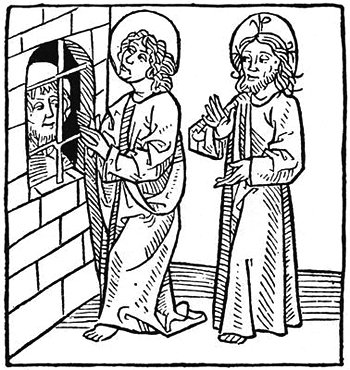
The Baptists' Doubt

I generally try to refrain from commenting on the Sunday Gospel readings in my posts; I've always felt that was better left to the homilists, our priests, to proclaim from the pulpit as they are ordained to do.  But today I could not help but share some thoughts on today's Gospel passage, that contains such a striking and representative dialogue between John the Baptist and the Messiah, the Christ whose coming it was his mission to announce.

The passage, Matthew 11:2-11, opens with John, from behind prison bars, posing a very direct question to the Christ, "Are you really he who is to come, or shall we look for another?"  Put a bit more plainly, John, who leapt in Elizabeth's womb at the sound of Mary's greeting as she carried the Savior of the world (Luke 1:44), is now faced with a twinge of doubt.  He is essentially asking the same question that everyone who dares to call themselves a Christian must ask of Christ at some point, and that more than likely we ask multiple times throughout our lives: Are you really who you say you are, the Messiah, the Holy One of God?

John's doubt, just like our doubt, is never a bad thing in and of itself.  God encourages us to question him, to seek him out, because it is only in doing so that we look beyond ourselves and come to know him more deeply.  It is our attitude that determines whether the doubt is ultimately an avenue to spiritual fruit--salvation--or destruction.  More on that in a second...

First, let's briefly examine Jesus' response.  Far from rebuking John's questioning, he uses it as an opportunity to reaffirm John as the one who was prophesied from of old to herald the coming of God in the flesh (Isaiah 40:3).  In doing so, he accomplishes two very specific things, which he also seeks to accomplish in each and every one of us if we are truly open to his will.

First, he quells John's doubt and offers him the satisfaction from despair, that his life and suffering have not been in vain.  Isn't that what we all long for, reassurance that all of the hardships we face in this life, especially the ones that come because we are striving to live an authentic Christian life, are not in vain?  Although Christ may not always give us the comfort of feeling that we are living and suffering for a purpose, he gives us something much more important than feeling:  he gives us fact.  He gives Himself, the Truth incarnate, as an assurance (see my previous post about fact vs. feelings).  He gives us the Eucharist, a blessing beyond compare that not even the Baptist himself was able to partake of during his life and mission on Earth ("yet he who is least in the kingdom of Heaven is greater than he").

Second, in reaffirming John's mission, he also, in a roundabout way, confirms his own identity as the Savior, the God-Man who a fallen world has longed for since the first sin.  He brings everything back to himself, because ultimately it is only in him that anything has purpose and meaning.  Apart from him our lives are purposeless; apart from him we can do nothing (cf John 15:5).

Ultimately, within our dialogue with Christ, our attitude and openness to his reply is the avenue that allows his salvation to take effect in our lives.  Either we end up closed like the Pharisees, with an agenda of constantly trying to trap Jesus in his own words and refusing to surrender their own self-centered view, or we end up like John here.  Like him, like the Samaritan woman at the well, and like the many other saints who have asked openly and honestly, who have sought to know God as he his, not as we would make him to be, and to live according to the Truth of his reply, if we are open to him the kingdom that he has promised will become our inheritance.  Christ stands always at the door, ready to answer "anyone who has ears to hear."  Let us, like John, ask humbly and honestly, and be willing to receive him regardless of the consequences, because we know that the eternal consequence that he has promised for those who love him are far beyond anything we could ever imagine.

+AMDG+

Thursday, October 21, 2010

Thank You Archbishop Burke!

Finally, some words of crystal clarity, thrown down like a gauntlet by one of the highest officials in Rome (who, ironically, during his time as the Archbishop of St. Louis, was much-derided by Catholics of the more...how shall I say this...liberal bent). As the sitting Prefect of the Supreme Tribunal of the Apostolic Signatura, Archbishop Burke (Cardinal-designate Burke as of yesterday, to be installed November 20) holds the highest judicial authority in the Church after the Holy Father himself.  He delivered a keynote address to a major congress in Rome last week hosted by Human Life International, in which he derided so called "cafeteria Catholics" who give into the temptation "to view the magisterium in relation to his individualism and self-pursuit.He held nothing back, calling out first and foremost bishops who have given into such temptation and left their flock to be scattered by the wolves of a society that teaches us to "believe what is convenient and to reject what is difficult for us or which challenges us."


He also left no doubt about the hypocrisy of so-called Catholic politicians and others who publicly disobey and refuse to live according to the magisterium in every day life:


"We find self-professed Catholics, for example, who sustain and support the right of a woman to procure the death of the infant in her womb, or the right of two persons of the same sex to the recognition which the State gives to a man and a woman who have entered into marriage. It is not possible to be a practicing Catholic and to conduct oneself publicly in this manner.”


He lamented the scandal that it as wrought, "that many have become confused about 'the most basic truths,' namely the inviolable dignity of innocent human life from conception until natural death, and marriage of one man and one woman 'as the first and irreplaceable' source of life and society."


We have been looking for these words from Rome for a long time, since we are not hearing them from many of our own pulpits.  Even better that they should come from an American.


Read the article: A Plea for Life, Truth, and Obedience (Zenit.org)

+AMDG+

Wednesday, October 20, 2010

Hearts According to God's Own

Yesterday was the feast of Saints Isaac Jogues, John de Brebeuf, and companions, French Jesuits who were martyred in the mid-17th Century while carrying the Gospel to the natives in the New World.  Last night as I was reading through the account of their missionary experiences, frought with pain, captivity, and frightful torture at the hands of the people who they came to bring the love of the Gospel to, I could not help but wonder:  what did these men possess that enabled them to endure such suffering and hardship, and to do it with such great joy?  They were willing to preach the Gospel and try to negotiate peace with a nation who came to despise them as sorcerers, and they returned literally again and again.

Contrast that with today, when we Catholics (myself included) are so hesitant to speak the name of Jesus and share Him with those around us who do not believe, for fear that we might be shunned socially, professionally, or worse by our own families.  Why?  What's holding us back?

Some members of the Church throughout the world face the same kind of suffering and "martyrdom of the red" today, where the Church is physically persecuted, but most of us do not face the threat of physical hardship for the faith.  Unfortunately, in many ways it seems the Church in America has allowed itself to be lulled into a hazy, sleepy faith, where many do not even know the faith, let alone being able to proclaim it.  We end up more bored in the presence of Christ than burning with grateful love for the fact that God himself came to live with us and share in our suffering and death so that we might be raised up into His eternal life.

It would do us well to rediscover the stories of many of the martyrs and tell them to our children, but first and most especially to meditate on what their lives and deaths point us to: the love Christ poured out for us (literally) in His passion, death, and Resurrection.  Let us pray for the reality of that burning love to be driven deep into our hearts and light them on fire.  Let the words of Saint John de Brebeuf in a letter he wrote encouraging would-be French missionaries to come to the New World, ring just as true to us today, as we are faced with a "brave new world" of radical secularism and indifference:

"We have learned that the salvation of many innocent souls, washed and whitened by the Blood of the Son of God, is stirring deeply the hearts of many men, inflaming them with fresh desires to leave Old France and come to the New.  May God be forever blessed!  By this means he has showed us that he has finally opened up to these tribes the depths of his infinite mercy.  Far be it from me to chill the ardor of the generous resolutions of those noble souls who aspire to become missionaries.  Theirs are hearts according to God's own, and we are eagerly awaiting for them...
It is true that "love is strong as death" (Sg 8:6); that the love of God has power to do what death does--that is, detach us entirely from creatures and even from ourselves!...
When you reach the land of the Hurons, you will indeed find our hearts full of love.  We will receive you with open arms as we would an angel from paradise."
 Saint John de Brebeuf (+1649)
+AMDG+


Sunday, September 26, 2010

Fear Not!

Yesterday while flipping through the channels as a self-reward for completing a homework assignment, I stumbled upon an episode of Archbishop Fulton Sheen's "Life is Worth Living" series on EWTN.  I'm not an EWTN watcher and although I've heard of his series, I'd never taken the time to seek out and watch them.  That might change now.  Once I got past the antiquated black-and-white, the immediate realization came to mind: this man was a master communicator, and his message was crystal clear.  My DVR is set to record the series now.

Archbishop Sheen's message in the episode that was a topic that I am trying to make into a four letter word: FEAR.

That's right, the other four-letter word.  The one we think about so much, but may never talk about or face head-on.  Archbishop Sheen opened by referencing a 1927 speech by Joseph Stalin on the coexistence of Communism and Capitalism in the 20th Century.  His initial point was as provocative then as it is now, and caught my attention:

Deep down, any desire for "coexistence" and "world peace," that is not rooted in genuine love and God's plan as revealed in Christ, ultimately stems from a source other than God: fear.  That fear takes two forms: first, psychological fear, created by the tensions that exist between men because of our sinful nature, and second, the concrete, physical fear of suffering or death.  Both of those fears have been present throughout human history since the fall; in the 1950's they were manifested by the looming threat of nuclear war, which the fear of MAD (mutually assured destruction) ultimately kept at bay.  Today, terrorism and economic uncertainty lead us to fear the unknown and unknowable future.

Archbishop Sheen pointed out the fact that we are fed an almost constant diet of fear, particularly in the media.  We are literally taught to live in fear: fear of serious illness or injury and the effects it might have, fear of losing a job or not making the next promotion, fear of losing a loved one who is close to us, even fear of not looking "good enough" or "fitting into the right crowd."  This list is endless, but you get the point.  There is a fine line that legitimate concerns and responsibilities in life cross to become fears that define the way we live.  That line is Christ.

By a quick count, we are commanded explitily not to fear or live in anxiety at least half a dozen times in the New Testament alone (Mt 10:26-28, Lk 12:7, Mt 14:27, Mk 5:36, Rev 1:17 & 2:10), and dozens of other times implicitly using the negative examples of people who lived in fear.  Probably the most famous issuance of this command was Matthew's account of Christ walking on the water toward the Apostles, whose boat is being tossed about by the stormy sea: "Take courage, it is I; do not be afraid" (Matthew 14:27).  The Apostle Paul likewise cautions us in his letter to the Philippians, "Have no anxiety about anything, but in everything by prayer and supplication with thanksgiving let your requests be made known to God.  And the peace of God, which passes all understanding, will keep your hearts and your minds in Christ Jesus (Phil 4:6; emphasis mine).  I emphasize the anything and everything because Jesus' command, and Paul's exhortation in support of it, are given as absolutes.  There are no exceptions.  There are no ifs, and, or buts.

The world offers us many temporary antidotes to our fear: everything from better medication and medical care, to the latest safety gadets and techniques, psychotherapy and meditation, better and more efficient ways of communicating, etc.  Each of those has their place and is none is bad in and of itself, but where they become dangerous is when we begin to put our ultimate trust in stuff--in the "expert advice"--instead of in our loving Father.  In fact as we see so much in our secularized world today, they can lead to a self-reliance and reliance on governmental and socio-economic structures to the exclusion of God.  Ironically, society makes us a promise that ultimately only God can make: that, if we trust it (instead of Him), everything in the end will be okay.  Worldly fear ultimately leads us to distrust a perfect, all-powerful and unconditionally loving Father in favor of our own limited, broken, and fallible human will and intellect.

But the Father has given us a cure for our fear, and for everything else that wears us down and divides us: love.  For "There is no fear in love, but perfect love casts out fear."  (1 John 4:18)  That perfect love is not some abstract, intangible idea as we would imagine it.  It is the limitless but very tangible love that is a person, Jesus Christ.  That is a whole post in itself, so more on that for a later time. 

Archbishop Sheen ended the episode by contrasting two images, a pyramid and a healthy, flourishing tree, to illustrate the difference between false, man-made peace, and the peace of God.  Society (without God) establishes itself like a pyramid, trying to dictate its utopian notion of a peace from above.  As history has proven, that system does not work and is doomed to fail because true peace that only comes as a byproduct of love and trust, does not take hold.  True peace grows much more like a tree, where the individual members (you and I) are roots watered and sustained by love--first of God, then of neighbor as self--and strengthened by the concrete morality that is rooted obedience to his Commandments.  Those roots grow and feed a healthy society, which ultimately reaches skyward and points toward the eternal Kingdom of Heaven.

Jesus taught us perfectly what it means to trust the Father, and lived what he taught to the death.  Living without fear does not mean that we will not undergo trial and suffering, only that if we join it with the suffering of his passion and crucifixion, we have the Resurrection as a promise that he will bring us through all of it and into eternal glory.  For "the sufferings of this present time are not worth comparing with the glory that is to be revealed to us" (Romans 8:18).  I don't know about you, but that sounds much better than just a few decades (if we're lucky) of being comfortably okay.

Sunday, September 12, 2010

Lost and Found

Every so often, circumstances in life converge to create a state where it starts to feel as though we're being more dragged along for the ride than everything being under control.  Commitments, expectations at work, and all the other details of life begin to crowd in to the point where other, ultimately more important and necessary things--like our relationship and communication with God--start to get inched to the wayside.  When Christ and our relationship with him start to slip from the center toward the periphery, it is inevitable that we will substitute ourselves, and all the baggage we carry with us.  That is when things start to go awry.

I didn't realize it until this past week, but that is exactly what has been happening to me these last few weeks and months.   The details began to creep in--slowly, one by one, almost impercebtibly--to the point that my relationship with God, and with my wife, and general order in life, began to suffer.  It happens once in a while, and I usually rely on her to let me know (as she so gracefully does) that my "stress index" has increased to the point that I need to step back, take a spiritual and mental breather, and recage priorities.

Ultimately, I needed to do what all of us so often need to, to let go of my grasp on life.  I needed to feel God's presence again, not just in a superficial, sentimental way, but with that deep, peaceful command that comes when we let the one whose voice calmed the raging sea take control: "Take courage.  It is I."  I needed to recover daily time with him that I had started to let other things cut into.  I needed to be still and know that he is God.

The best place to recover this peace was--you guessed it--Confession and Eucharistic Adoration.  So we went and, true to form, Christ was right where he promised to be and always is, with us here and now, and forever.  Even more, as they usually do during Adoration, his words (today's reading from Luke 15) cut right to the quick of what I was experiencing.  Jesus' use of the the three parables of loss--the lost sheep, the lost coin, and the lost son--opened my eyes to the fact that I had, in fact, been losing touch with him.  As he spoke to me through his words to the Pharisees and Scribes, the truth of the experience became crystal clear:

Our loss, or being lost, is just as often a "slow fade" from remaining centered on Him as it is a catastrophic fall into serious sin.

Whether or not we like it, Satan knows us.  He knows that if Plan A, to convince us that God doesn't exist, and Plan B, to swindle us into destruction through serious sin, both fail, he can always resort to Plan C, to lure us slowly away from Christ and pull our gaze off of Him using the details and anxieties of everyday life, however innocent and well-meaning they may be.  He does it impercebtibly, hoping that we will not notice until Christ has been edged out of our life entirely and all that's left of our relationship with him is an empty, nostalgic memory.  Either way, we fall precisely into the original sin that he lured Adam and Eve into in the garden, to start to seize control of our lives instead of allowing God to remain in the driver's seat and clinging with love and adoration to his plan for our life and salvation. Even though none of the details that pulled us away from him may be evil in itself, they can lead us directly into violation of the First Commandment: "I am the Lord your God.  You shall have no other Gods besides me." That includes work, school, and anything else that we allow to take the place that is rightfully his.

But, thankfully, God allows us to feel the "righteous anxiety" that comes when we lose our focus on him and on submitting ourselves in obedience to his will.  He gives us the grace to sense the chaos that slowly but surely ensues, in hopes that we will repent.  Even more than that, like the Father of the lost son, he stands always there with open arms, present in the Sacrament of the Altar, waiting for us to return to his arms and into joy, love, and peace that passes all understanding.

Lord, do not let us be lost by having our eyes drawn away from you.  Help us to keep our gaze always fixed on your cross, that we may live all aspects of our life with an awareness of its power and of the eternal life that you have destined us for through your death and Resurrection.