As we take a day off from our busy lives to gather with friends and family and celebrate this holiday we call Thanksgiving, a quick thought came to me that I felt I ought to share.
We know the things that we give thanks for: family and friends to share love with, food, a warm roof over our heads, the relative security of not having to worry where our next meal or shower is going to come from...the good. These are not universal, but are the vast majority in a society that has more abundance and wealth than many in the world know or have known; they basic things in life that no human being should be deprived of.
But, equally as importantly as what we are thankful for, there is the flipside. Thanksgiving is not just a day, it's both an attitude and an action. If it is an action, there must be an object of that action; something (or someone) to whom that thanksgiving is directed. I won't get too deep into it, but suffice it to say that our society that has been blessed with so much wealth, seems to be turning away from--or at least ambivalent to--the one who is the source of all wealth, love, truth goodness, and beauty. All of these are His; we are blessed with them, but in the end we are just custodians of these gifts, especially of love, and will be called to account how we used them.
So, as we pause to give thanks, let's be mindful of the One to whom we are ultimately thankful. This mindfulness and thankfulness is contagious, so let it flow like all of His blessings.
Thank God! Give him the praise and the glory. Before all the living, acknowledge the many good things he has done for you, by blessing and extolling his name in song. Before all men, honor and proclaim God's deeds, and do not be slack in praising him. (Tobit 12:6)
Thursday, November 28, 2013


Monday, October 28, 2013
The Five W's Part One: Why I Believe
"Always be ready to give an explanation to anyone who asks you for a reason for your hope." (1 Peter 3:15)
As I mentioned in the introductory post on the Five W's, these posts on these five basic questions of the faith won't be in any particular order. In fact, I'll just start with the order in which I've been led to think about them, beginning with...
"Why do I believe?"
The opening imperative issued by St Peter, as with all imperatives, is given for a reason. In the case of effectively understanding and explaining why we believe, it's because, without an answer to this question first, all of the other questions of faith become a moot point. At our most basic level, we operate off of needs and desires. Our God realizes that. In fact, he made us that way. He created to desire his truth, goodness, and beauty. Unfortunately, those desires have become twisted and distorted, and the recognition an acceptance of that fact leads to the first part of the answer to the question of why.
1. I believe because I recognize that I am not as I ought to be, and the world is not as it ought to be.
I look out at the world around me, and at the same time into my own soul, and realize that, although there is truth, goodness and beauty, and a desire for more of it, without end, I am constantly disappointed by my own failings, the failings of people around me, and of society at large. I know that the good things, the truly good things, of this life seem so fleeting, but I cannot believe that the desire for truth, goodness, and beauty, can not have come into my mind and heart without an object, and without some echo of knowledge of how things ought to be. As the Sugarland song "Something More" go,
There's gotta be something more, gotta be more than this
I need a little less hard time, I need a little more bliss
I'm gonna take my chances, taking a chance I might
Find what I'm looking for
There's gotta be something more
2. There is evil in the world.
Evil seeks to lie, destroy, and kill. It is real. It exists, yet it has been said that its greatest achievement is convincing the world that it doesn't. It is so important to convince the world that it doesn't exist because confronting evil, especially the sin in each of our souls, is something we are utterly powerless to do on our own. However, when we do decide to confront it, to seek healing and truth (if we are honest), and that search for healing and truth leads us to look outside ourselves. See #1.
3. Yet, despite the evil, there is still so much good.
Despite all the evil that we encounter during our sojourn in this valley of tears, there is still so much good, beginning first and foremost with the human heart. Though society would minimize the power of the human heart, we see its capacity to do good, especially in helping neighbors in the face of suffering. Though it may sound sort of like a cheesy movie line, there is a hero in each of us, capable of great love and ultimately called to shine brighter than the stars. We have the capacity to bring and do so much good in the world. Evil never has the last laugh. As the great Christian apologist C.S. Lewis put it,
“How monotonously alike all the great tyrants and conquerors have been; how gloriously different are the saints.”
4. I will die. Yet, because of my experience of good, however fleeting in this life, I cannot believe that death is the end.
A dear priest friend once began one of his homilies with that simple statement: I will die. Let that sink in for a minute. In fact, try to spend a few minutes a day--particularly at day's end--allowing it to make the journey from head to heart, not in a dark, obsessive, and avoidant way, but in an acceptance of reality that allows one to look beyond it. So many of the great saints have encouraged frequent contemplation of the moment of our death because it keeps us grounded in our humanity and limitations. In fact, one of the greatest successes of evil in more affluent society is in removing so much of the reality of human death from our immediate experience. Yet it remains the disease that we cannot cure, the effect of our allowance of sin into the world. But, thinking back to #3, just as I know that evil does not have the last laugh in the world, I cannot believe that its primary objective of death and destruction has the last word, particularly for those who believe in the One who has conquered death and who makes all things new. That is why the Resurrection is so important: because without it, death continues to reign as the great tyrant and scourge over humanity. But in the Resurrection its power has been routed; it has been transformed into the beginning of eternal life. Faced with that choice, the uncertainty and lack of resolute answers the world gives about the condition it cannot fix vs. the promise of eternal life made concrete by Christ's Resurrection, I choose the latter every time.
Psalm 84:1-5, 11-13, is a constant reminder of the beauty of God's dwelling place, which he has given us a taste of here on earth and calls us to enter into with him. After all, he seeks to create a space for himself, a little heaven if you will, in each human heart; a place over which death and the pain of our human condition have no power.
+AMDG+
As I mentioned in the introductory post on the Five W's, these posts on these five basic questions of the faith won't be in any particular order. In fact, I'll just start with the order in which I've been led to think about them, beginning with...
"Why do I believe?"
The opening imperative issued by St Peter, as with all imperatives, is given for a reason. In the case of effectively understanding and explaining why we believe, it's because, without an answer to this question first, all of the other questions of faith become a moot point. At our most basic level, we operate off of needs and desires. Our God realizes that. In fact, he made us that way. He created to desire his truth, goodness, and beauty. Unfortunately, those desires have become twisted and distorted, and the recognition an acceptance of that fact leads to the first part of the answer to the question of why.
1. I believe because I recognize that I am not as I ought to be, and the world is not as it ought to be.
I look out at the world around me, and at the same time into my own soul, and realize that, although there is truth, goodness and beauty, and a desire for more of it, without end, I am constantly disappointed by my own failings, the failings of people around me, and of society at large. I know that the good things, the truly good things, of this life seem so fleeting, but I cannot believe that the desire for truth, goodness, and beauty, can not have come into my mind and heart without an object, and without some echo of knowledge of how things ought to be. As the Sugarland song "Something More" go,
There's gotta be something more, gotta be more than this
I need a little less hard time, I need a little more bliss
I'm gonna take my chances, taking a chance I might
Find what I'm looking for
There's gotta be something more
2. There is evil in the world.
Evil seeks to lie, destroy, and kill. It is real. It exists, yet it has been said that its greatest achievement is convincing the world that it doesn't. It is so important to convince the world that it doesn't exist because confronting evil, especially the sin in each of our souls, is something we are utterly powerless to do on our own. However, when we do decide to confront it, to seek healing and truth (if we are honest), and that search for healing and truth leads us to look outside ourselves. See #1.
3. Yet, despite the evil, there is still so much good.
Despite all the evil that we encounter during our sojourn in this valley of tears, there is still so much good, beginning first and foremost with the human heart. Though society would minimize the power of the human heart, we see its capacity to do good, especially in helping neighbors in the face of suffering. Though it may sound sort of like a cheesy movie line, there is a hero in each of us, capable of great love and ultimately called to shine brighter than the stars. We have the capacity to bring and do so much good in the world. Evil never has the last laugh. As the great Christian apologist C.S. Lewis put it,
“How monotonously alike all the great tyrants and conquerors have been; how gloriously different are the saints.”
4. I will die. Yet, because of my experience of good, however fleeting in this life, I cannot believe that death is the end.
A dear priest friend once began one of his homilies with that simple statement: I will die. Let that sink in for a minute. In fact, try to spend a few minutes a day--particularly at day's end--allowing it to make the journey from head to heart, not in a dark, obsessive, and avoidant way, but in an acceptance of reality that allows one to look beyond it. So many of the great saints have encouraged frequent contemplation of the moment of our death because it keeps us grounded in our humanity and limitations. In fact, one of the greatest successes of evil in more affluent society is in removing so much of the reality of human death from our immediate experience. Yet it remains the disease that we cannot cure, the effect of our allowance of sin into the world. But, thinking back to #3, just as I know that evil does not have the last laugh in the world, I cannot believe that its primary objective of death and destruction has the last word, particularly for those who believe in the One who has conquered death and who makes all things new. That is why the Resurrection is so important: because without it, death continues to reign as the great tyrant and scourge over humanity. But in the Resurrection its power has been routed; it has been transformed into the beginning of eternal life. Faced with that choice, the uncertainty and lack of resolute answers the world gives about the condition it cannot fix vs. the promise of eternal life made concrete by Christ's Resurrection, I choose the latter every time.
Psalm 84:1-5, 11-13, is a constant reminder of the beauty of God's dwelling place, which he has given us a taste of here on earth and calls us to enter into with him. After all, he seeks to create a space for himself, a little heaven if you will, in each human heart; a place over which death and the pain of our human condition have no power.
How lovely your dwelling
O LORD of hosts!
My soul yearns and pines
for the courts of the LORD.
My heart and flesh cry out
for the living God.
As the sparrow finds a home
and the swallow a nest to settle her young,
My home is by your altars,
LORD of hosts, my king and my God!
Blessed are those who dwell in your house!
They never cease to praise you.
Better one day in your courts
than a thousand elsewhere.
Better the threshold of the house of my God
than a home in the tents of the wicked.
For a sun and shield is the LORD God,
bestowing all grace and glory.
The LORD withholds no good thing
from those who walk without reproach.
O LORD of hosts,
blessed the man who trusts in you!
+AMDG+
Monday, October 14, 2013
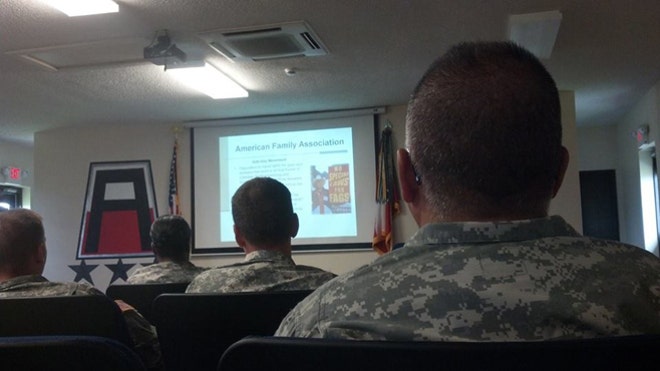
US Army defines Christian ministry as 'domestic hate group'
EXPANDED 10/16/2014
Another day, and another instance of our own military being turned against the prevailing views of the majority of its citizens:

Another day, and another instance of our own military being turned against the prevailing views of the majority of its citizens:
US Army defines Christian ministry as 'domestic hate group'
I have to agree with Todd Starnes' conclusion, that "it appears the Obama administration is separating the military from the American people – and planting seeds of doubt about Christians and some of our nation’s most prominent Christian ministries."
What pains me the most is, having spent the first decade-and-a-half of my adult life in the military, I know and have seen the power of the warrior ethos and the camraderie brought about through our military traditions. However, when those traditions pull away from (or are pulled away from; shifts like this don't happen by accident), the bedrock beliefs of the nation that gives birth to them--in our case, the Judeo-Christian ethical and moral structure and willingness to sacrifice for the good of the whole--the seed is planted for the ideal of the citizen-soldier to broken down into a warrior caste with less and less connection to to population it is supposed to serve.
Let us only hope that, despite the fact that movements like this cast yet another cloud over the role of faith in the military and the chaplaincy that serves it, that we will all have the courage to speak out against it and have express that faith and the truth of the heroism that we are called to as Navy Captain Francis Castellano has.
Sunday, October 13, 2013
The Five W's
 Actually, it's the four "W's" plus "H." It's a generic format of questioning that I've always found useful when beginning to look into the facts of a matter, whether it's deciding what I've got to do around the house or answering a question at work. It's a tool that stuck with me from my early days in the military, and continues to prove useful to this day; whenever there is a question to be answered or a basic report to be given, make sure that at least the "five W's" are covered.
1. Who?
2. What?
3. Why?
4. When?
5. How?
I don't know why it never occurred to me earlier, that this same basic method of questioning might prove to be just as good at kicking off a good, basic spiritual exercise (I've been overdue for one) as it is at answering the pragmatic issues that come to us in day to day life. After all, in the end, what is more pragmatic than our relationship with Christ and his Church, from which all else that is true, good, and beautiful, flows?
So, in the next few weeks, check back for a short series of posts, where I'll share my basic thoughts on the answers to five basic question of the faith:
1. Who do I believe?
2. What do I believe?
3. Why do I believe?
4. When do I believe (i.e., when is my faith called into action)?
5. How do I believe (how do I surrender to the faith, and how is that faith supposed to be demonstrated)?
No heavy stuff, no fluff (not a lot anyway). Just a pure, unadulterated, back-to-basics spiritual exercise to till the soil a bit...and get me back on a regular blogging.
+AMDG+
Sunday, June 2, 2013
Gods and Goddesses
While life has been happening, this blog has not. In the last few months, we have:
- Left behind 10 years of the familiarity of military life
- Moved half way across the country (to be closer to L's family)
- Begun a new career
and...I've let all of that get in the way of the nudging I've been feeling to "get back after it."
I'm not sure exactly what direction that nudging will take at this period of our lives, but how often do we when we begin down one of those forks in the road, be they large or small?
So, I guess the long and short of it is, we'll see.
Separately, another "nudge" recently came in response to my prayer for help and clarity in dealing with a couple of difficult situations that have arisen at work. While there hasn't been a crystal clear, lightning-bolt-from-the-heavens answer (again, how often does that happen?), I was prompted to pick up a book that Dr. Peter Kreeft published a couple of decades ago and mentioned after a recent talk was his favorite: Heaven: The Heart's Deepest Longing.
I'm only half way through it, but it has reminded me of the desperate need to spend significant, dedicated time in contemplative prayer--particularly adoration--and spiritual reading, both of which I had been neglecting. Contemplative prayer is the time when the Lord speaks to our heart, sometimes in whispers and sometimes more. It is the time when he feeds us mentally and reminds us of His perspective on things when we can so easily get lost in our own corner of the world. Most importantly (for me, at least), it's the time among the beautiful, busy times of family life, work, relationships, and everything in between, when He reminds us who we are--sons and daughters of God, co-heirs with Christ, destined for a share of his divine, eternal life beyond our wildest imaginings. This contemplation goes beyond the "be still and know that I am God" moments that are completely necessary; we can carry it with us into the moments of our daily lives to allow him to speak the peace and perspective into all of them, ordinary or chaotic.
Dr. Kreeft shares an excerpt from C.S. Lewis' The Weight of Glory that his this home point-blank:
It is a serious thing to live in a society of possible gods and goddesses, to remember that the dullest and most uninteresting person you can talk to may one day be a creature which, if you saw it now, you would be strongly tempted to worship, or else a horror and a corruption such as you now meet, if at all, only in a nightmare. All day long we are, in some degree, helping each other to one or the other of these destinations...There are no ordinary people. You have never talked to a mere mortal. Nations, cultures, arts, civilisations--these are mortal, and their life is to our as the life of a gnat. But it is immortals whom we joke with, work with, marry, snub, and exploit--immortal horrors or everlasting splendours.
Wow! count on C.S. Lewis (and Dr. Kreeft) to give a little of that contemplative perspective. God speaks to us, and counts on us to speak to us and love each other into relationship with Him. What an awesome responsibility; unfortunately, one that we so often let life and the lure of the world get in the way of, but that he is ever faithful about gently nudging us back to.
+AMDG+
Subscribe to:
Posts (Atom)